
engagement-rings
Unisex Engagement Rings
Why the engagement ring as a design category is expanding past a binary it never had to fit — and what unisex actually means in fine jewellery.
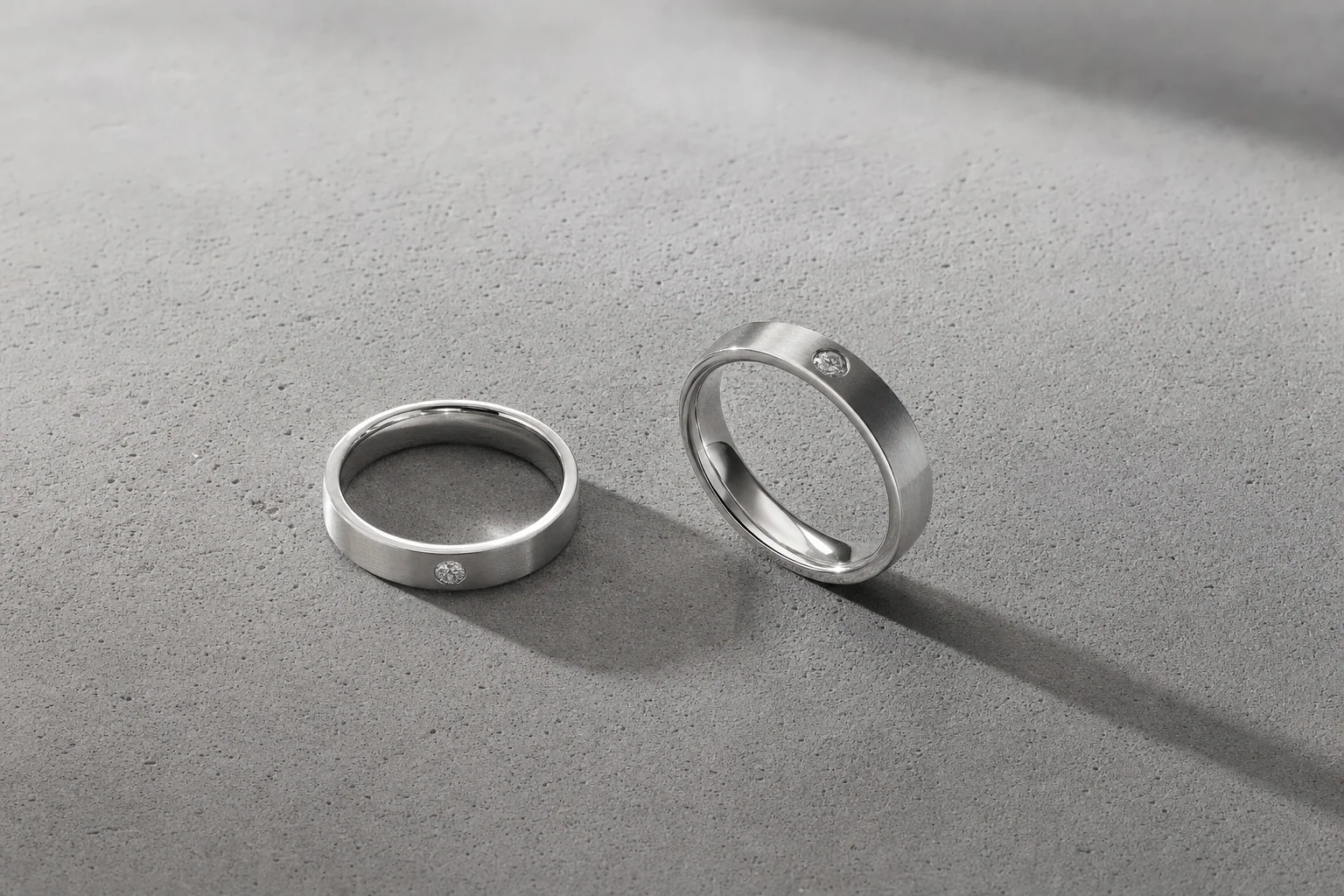
Until very recently, the engagement-ring industry assumed a single grammar: one person proposes, the other receives, the design vocabulary is gendered accordingly. That assumption is breaking down — not as a marketing trend, but as a reflection of how relationships actually exist. This piece explains what “unisex” really means in fine jewellery, what design decisions make a piece truly gender-agnostic, and why the shift matters beyond inclusivity language.
What unisex actually means in a ring
A unisex ring is not a watered-down compromise. It is a piece deliberately designed so that the proportions, silhouette, finish and feel work across hand sizes and stylistic preferences typically associated with different genders. Done well, it does not look like a ring “for either.” It looks like a confident piece whose audience is the wearer, whoever the wearer is.
Specific design decisions that make a ring genuinely unisex:
Proportional band width. Traditional women’s bands hover around 1.8–2.2 mm. Traditional men’s bands run 4–8 mm. A unisex band typically lives in the 2.5–3.5 mm range — substantial enough to read as architectural, slim enough to wear comfortably on a slimmer finger.
Setting profile. Ultra-tall solitaire heads read as feminine to most eyes; flat-set bezel or flush settings read as masculine. A unisex setting tends toward medium-low profile — confident but not towering, which makes the piece more wearable across hand types and more durable across active lives.
Surface finish. High-mirror polish reads luxe-feminine; satin or brushed finishes read luxe-masculine. Mixed-finish pieces — polished bezel against a brushed band, or a polished interior against an exterior matte — sidestep the binary entirely and create a more interesting object.
Stone choice. Round brilliants in white diamond are gender-neutral by tradition. Coloured stones — deep blue sapphire, indicolite tourmaline, dark teal alexandrite — open another register entirely, often more interesting than the default.
Why the shift is structural, not cosmetic
The engagement-ring industry that emerged in the twentieth century was shaped by a specific marketing apparatus that codified the gendering. De Beers’ “A Diamond Is Forever” campaign and decades of subsequent advertising shaped the expectation that engagement rings flow in one direction, from a male giver to a female receiver, and that the piece itself should encode that giver’s display of commitment.
The relationships that exist today do not fit that model uniformly. Couples where both partners wear engagement rings. Couples where the proposing role is not gendered. Couples where there is no proposal at all, and the rings are chosen together as joint statements of commitment. Couples of the same gender, where the script breaks entirely. Single people commissioning rings for themselves to mark life milestones.
The maison serving these relationships needs design vocabulary to match. That is what “unisex” is — not a category in a catalogue, but a competence the atelier has to develop.
What changes in the conversation
When a couple arrives at the atelier wanting paired engagement rings, the conversation is different from the single-proposer model. We ask different questions:
- Do both partners want the same piece, or do you want a coherent pair with intentional differences?
- Will the rings carry a shared engraving, a matched stone, a parallel design line?
- How will the pieces be worn — both partners daily, or one daily and one for occasions?
- Are you choosing your own piece, or designing your partner’s piece as a gift?
Answers to these questions reshape the brief. We move from designing “the engagement ring” to designing the pair — or designing two rings whose relationship to each other is part of what makes them work.
What unisex doesn’t mean
Unisex doesn’t mean plain. It doesn’t mean ungendered to the point of invisibility. It doesn’t mean abandoning ornament or stone or character. The best unisex pieces are emphatically somebody’s — confident in their geometry, specific in their materials, owning their own visual register.
Unisex also doesn’t mean every couple should choose it. Couples who want a traditional solitaire engagement ring for one partner and a plain band for the other should have that. The point is that the design vocabulary should be wide enough to fit the relationship, not the other way around.
Where this is going
The next five years of fine jewellery will see this shift continue. More pieces designed for paired wear. More coloured-stone engagement rings outside the diamond default. More inclusive marketing imagery that does not assume the proposer’s gender. More ateliers that can design for a non-binary brief without making the wearer explain themselves.
This is not a fashion cycle. The world’s relationships are not a fashion cycle. The maisons that adapt will continue to serve. The ones that don’t will gradually find that the wedding aisle they were marketing to does not match the actual aisle.
ÊTRUNE designs engagement rings as objects intended for whoever will wear them. The brief comes first. The piece serves the brief.
A short reference
- What “unisex” means: designed so the proportions, finish and silhouette work across the spectrum of hand types and personal aesthetics typically labelled “men’s” or “women’s.”
- Design markers: medium band width (~2.5–3.5 mm), medium-low setting profile, mixed finishes, considered stone choice.
- Where it matters: paired engagement rings, non-traditional commitments, single-person commissions, same-gender couples, any context where the binary script does not apply.
- What stays the same: the same craft, the same gemological standards, the same +Care rhythm, the same ÊTRUNE ID record.
A ring is for the hand that wears it. The atelier’s job is to design accordingly.