
engagement-rings
Reimagining Love: Why Your Engagement Ring Doesn't Have to Be Traditional
The cultural script that produced the diamond solitaire engagement ring is a twentieth-century product — not an eternal tradition. What that opens up for the wearer who wants something else.
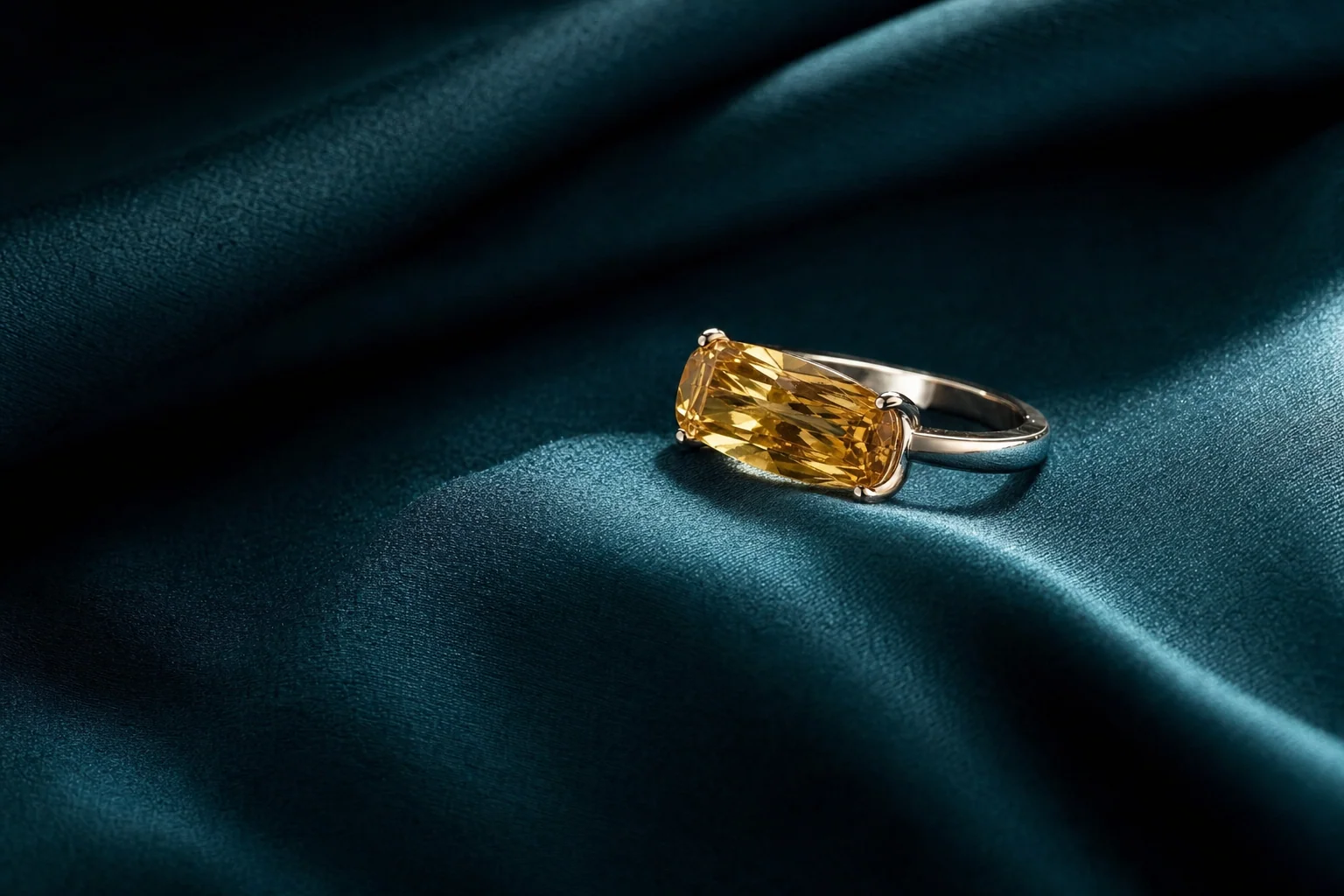
The image that most people summon when they hear “engagement ring” — a single round white diamond on a slim white-metal band — is a product of a specific twentieth-century marketing apparatus, not an eternal tradition. Understanding where the script comes from is the first step toward writing something else. This piece walks through how the modern default emerged, why it stuck, and what other paths are available for wearers who want their ring to say something the script does not cover.
Where the modern default came from
The expectation that an engagement ring should be a diamond solitaire took shape in the 1930s, 1940s, and 1950s, primarily through the campaigns of De Beers — particularly the “A Diamond Is Forever” campaign of 1947, which embedded the idea that diamond was the only appropriate engagement stone and that the appropriate spend was approximately two months’ salary.
This was not a recovery of an older European tradition. Diamond engagement rings existed before 1900 but were not the dominant choice; coloured stones (sapphire, ruby, emerald), pearls, and family signet rings all had significant share. The collapse of this variety into a single dominant default was a marketing achievement on the order of “Coca-Cola standardised Christmas red” — successful, persistent, and not eternal.
Knowing this matters. The wearer who feels obligated to choose a diamond solitaire because “it’s tradition” is responding to a tradition that is younger than air travel. There are older traditions and there are no traditions, both available.
What older traditions actually look like
Before the twentieth-century consolidation, engagement and betrothal rings across European, Indian, Persian, Chinese and Islamic traditions used a wide range of designs:
Coloured-stone centre rings — sapphire, ruby, emerald — were standard in European royal courts for centuries. The famous engagement ring of Catherine de’ Medici to the future Henri II of France was an emerald. Princess Diana’s sapphire-and-diamond engagement ring (now worn by the Princess of Wales) is in this older tradition; the modern moment that ring caused is partly because it broke the post-1947 default.
Posy rings — slim metal bands engraved with a phrase, usually in French (“amor vincit omnia” or similar) — were common European betrothal pieces from the medieval period through the nineteenth century. The “ring” was meaningful because of the inscription, not the gem.
Signet rings — engraved with a family crest or initials — functioned as both engagement and signature objects, sealing documents and identifying the wearer. Many cultures used signet rings as the primary symbol of marital union.
Gold band engravings in non-European traditions — Indian, Persian, Yemeni, Chinese — encoded religious texts, personal vows, or family names, sometimes accompanied by a single small gemstone, often no gemstone at all.
The point is that “tradition” as a category includes many things, and most of them are not a round white diamond solitaire.
What no-tradition looks like
If older tradition is one path, no-tradition is another. The wearer who wants a piece that owes nothing to any inherited script has a wide design space available:
A coloured stone the wearer simply loves. Teal sapphire, indicolite tourmaline, alexandrite, paraíba, spinel, garnet. Choosing because of personal aesthetic resonance, not because of symbolic correctness.
A geometric design with no centre stone. A wide band with detailed engraving, a sculptural piece with no gem, a paired set of architectural bands worn by both partners. The piece is the symbol; no stone required.
A custom design that encodes the relationship. Coordinates of a specific place. A date inscribed in a hidden location. A motif derived from a shared interest. The piece is unmistakably the wearer’s because nobody else’s looks like it.
A vintage or heritage piece. An estate ring chosen for its existing character, possibly reset by the atelier to fit the wearer’s finger and to refresh worn settings. The piece carries history rather than newness.
No engagement ring at all — the commitment is marked some other way (matched wedding bands only, a tattoo, a shared trip, a co-signed asset). This is increasingly common among couples who reject the engagement-ring economy entirely.
What “non-traditional” gets wrong
There is a marketing register that uses “non-traditional” as a synonym for “edgy” or “rebellious.” This misses the point. The wearer who chooses a teal sapphire engagement ring is not making a rebellion statement; they are simply choosing what they prefer. A non-traditional choice does not need to be a counter-cultural posture — it can be a quiet personal preference.
The maison serving these wearers should not amplify the “rebellion” framing. We should design the ring the wearer wants and let the rebellion narrative belong to whoever wants to claim it. A confident non-traditional engagement ring is one that looks like the wearer wanted it, not like it was selected to make a point.
What stays the same
Whether the wearer chooses a diamond solitaire, a coloured-stone heritage piece, a custom geometric band, or no engagement ring at all, certain things remain constant:
- The piece (if there is one) should be made well, with materials of certified provenance.
- The certificate (if applicable) should be honest and complete.
- The service rhythm — +Care for annual maintenance — applies regardless of design.
- The relationship continues with or without the ring.
A non-traditional engagement ring is no different from a traditional one in terms of the atelier’s commitment to it. The atelier serves the piece, regardless of which script the piece is or is not following.
Working with ÊTRUNE on a non-traditional brief
When a couple arrives wanting something outside the default, our process is:
-
Listen to the brief without translating it into the default. If the wearer wants no centre stone, we do not propose adding one. If the wearer wants a coloured stone, we do not propose a “small diamond accent” to bring it closer to the script.
-
Sketch from the brief. The design language of the piece emerges from the wearer’s reference points, not from a standard catalogue.
-
Use 3D modelling and AR preview to converge on a design before any material is committed. The same workflow applies whether the brief is conventional or radical.
-
Document the piece in ÊTRUNE ID with the same rigour as any other commission. The non-traditional piece deserves the same certificate, the same care record, the same future-proofing.
The brief is the work. The work serves the brief.
A short reference
- The modern default (round white diamond solitaire) dates to circa 1947, not earlier.
- Older European traditions include coloured stones, posy rings, signet rings, engraved gold bands.
- Many cultures (Indian, Persian, Chinese, Yemeni) never adopted the diamond solitaire default.
- “Non-traditional” is a description of preference, not a rebellion posture.
- The atelier’s commitment applies equally to traditional and non-traditional commissions.
The script is a script. The wearer can follow it, modify it, ignore it, or write a different one. The maison serves whichever choice is made.