
engagement-rings
Engagement Rings of Tomorrow
What changes when the engagement ring is no longer a fixed object — a measured look at personalization, material innovation, and the technologies that are rewriting the brief.
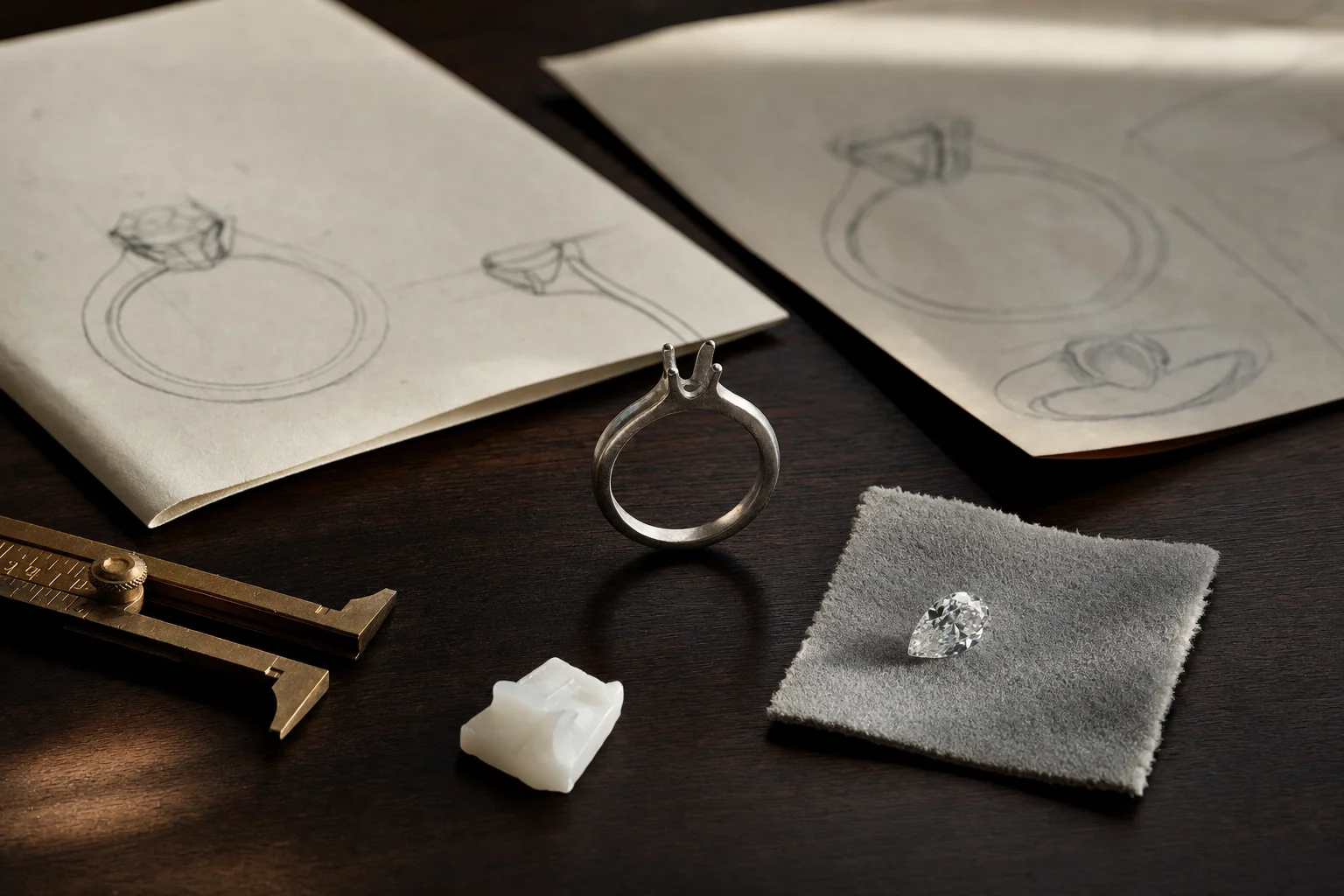
For most of the twentieth century, the engagement ring was a fixed object. A round brilliant diamond. A platinum solitaire. A specific list of acceptable variations, repeated across generations. That stability is breaking — quietly, in the choices couples are making today, and more visibly in the technologies and materials reaching the atelier floor. This piece looks at what is actually changing in the engagement ring of the next decade, and what stays the same beneath the surface.
The shift from selection to co-creation
For decades, the dominant experience of buying an engagement ring was selection: walking into a store, choosing from what was there, and leaving with one of a small set of permitted variations. That paradigm is being replaced by a different one — co-creation — where the couple participates in design decisions long before the ring exists.
The shift is not cosmetic. When a couple chooses a centre stone before deciding on a setting style, when they specify a metal palette, when they say “we like this proportion but not that one,” they are doing what only specialised ateliers used to do. The role of the maison shifts from gatekeeper to translator — turning a brief into a design, a design into a model, a model into a piece.
This is what we mean when we describe ÊTRUNE Builder as a co-creation surface. It is not a configurator in the e-commerce sense. It is an interface for a conversation that used to happen exclusively at a counter, now happening across timezones, with the same precision.
Materials are no longer fixed
The mined-versus-lab-grown conversation has stopped being a fringe one. Lab-grown diamonds are now indistinguishable from mined diamonds under standard gemological tests — they share the same crystal structure, the same hardness, the same optical behaviour. The only difference is origin, and origin is what the certificate is for.
A wearer choosing between lab and mined for a centre stone is choosing between two value structures. Lab-grown stones offer accessible price points and complete supply-chain transparency. Mined stones — when responsibly sourced and certified — carry geological history that some wearers value precisely because it cannot be reproduced.
ÊTRUNE works with both. The decision belongs to the couple. What we insist on is that the choice be informed, the certificate be present, and the ÊTRUNE ID record disclose the type honestly.
The same conversation extends to coloured gemstones. A teal sapphire from Madagascar, a Paraíba tourmaline from Brazil, an alexandrite from Hematita — each carries a different geological signature, a different ethical sourcing chain, a different price logic. The next decade of engagement rings will see far more coloured stones than the last, and the wearer will be increasingly literate in what they are choosing.
Augmented reality at the moment of decision
There is a category of purchasing decision — engagement rings, kitchens, sofas — that the internet has never fully solved. The wearer wants to see the object on themselves before committing. Photographs are not enough. Renders are not enough. You want to see how light moves over a band, how a stone catches the room, how the proportions sit on your hand.
Augmented reality, finally robust enough on consumer hardware, addresses this gap. A wearer can hold their hand up to a phone or laptop camera and see the proposed ring at scale, in real lighting, on their actual finger. They can rotate it, change the metal, change the stone, watch the colour shift. The model that was approved in 3D is now reviewable on the hand, weeks before it exists in metal.
This matters most for custom commissions. A piece that takes six to eight weeks of atelier time should not arrive as a surprise. AR closes that gap — what is finally produced is what was already worn virtually.
Personalisation that doesn’t break craft
The risk of any personalisation surge is that the craft suffers. If every ring is bespoke, the discipline of the trade — proportions that work, settings that hold, bands that wear well over decades — gets diluted by the demands of novelty.
The way out is structural. The maison keeps the boundaries: gemstones must meet specific clarity and cut standards, metals must be of certified provenance, settings must be engineered to hold for generations. Inside those boundaries, the wearer has wide latitude: stone shape, metal colour, setting style, profile of the band, finish, any inscription.
This is the model ÊTRUNE operates. The atelier guarantees the craft; the wearer chooses the language.
Designs that move with the wearer
The category of “modular” engagement rings — pieces that accept later modifications, additional stones, evolving settings — is still small, but growing. The idea is that the ring is not finished on the wedding day; it remains a piece of the wearer’s life that can mark anniversaries, milestones, generational transitions.
This is closer to the way fine jewellery worked before the industrial-engagement-ring era of the twentieth century. Pieces evolved. Stones were re-set. Bands were re-finished. The relationship between owner and object was longer than a single purchase moment.
A modern modular design can accept a small accent stone added at a fifth anniversary. A vintage band can be remounted at the moment of inheritance. The +Care annual visit is the natural moment for such evolutions to happen, because the piece is already in the atelier and already being documented.
The role of identity
Engagement-ring design assumed, for a long time, a binary that the world has moved past. One person proposed; the other received. The aesthetic vocabulary was scripted accordingly.
The next decade of design will continue to dissolve that assumption. Unisex bands, paired rings, exchanged rings, single rings for solo commitments, family rings restructured for non-traditional households — the ring as a category is expanding to fit the relationships that exist now.
A maison that builds rings has to be fluent in this vocabulary. Not as a marketing posture, but as a practical capability: knowing how to design a band that works on a wider hand, how to scale a stone for two paired pieces, how to discuss with a couple a design that is not centred on a single proponent. The atelier serves the relationship, not a script about the relationship.
What does not change
Underneath all of this, the durable core of the engagement ring remains unchanged.
A piece worn every day must be built to be worn every day. The metal must hold. The setting must protect the stone. The band must withstand decades of hand-work, hand-cream, hand-impact. The certificate must be honest. The service must continue.
Technologies and materials and personalisation will continue to evolve. The atelier’s responsibility — to make a piece that survives the life it is asked to live — does not.
A short reference
- What is changing: material options (mined vs lab), customisation depth, AR preview, modular adaptability, inclusivity of design vocabulary, transparency of sourcing.
- What is not changing: the requirement that a ring worn every day must endure every day, the importance of independent gemological certification, the value of an annual care rhythm.
- What ÊTRUNE commits to: documenting every piece in ÊTRUNE ID, supporting every piece with +Care, and welcoming every piece back through Upcycling when the time comes.
The engagement ring of tomorrow is not a radical departure from the engagement ring of yesterday. It is the same object, more honest about how it was made, more open to whose hand it is for, and more accompanied across the years that follow.