
technology
Revolutionizing 'I Do': How Industry 4.0 is Changing the World of Engagement Rings
3D modelling, AR preview, blockchain provenance, additive manufacturing — what Industry 4.0 actually means inside a serious atelier, and what it doesn't change.
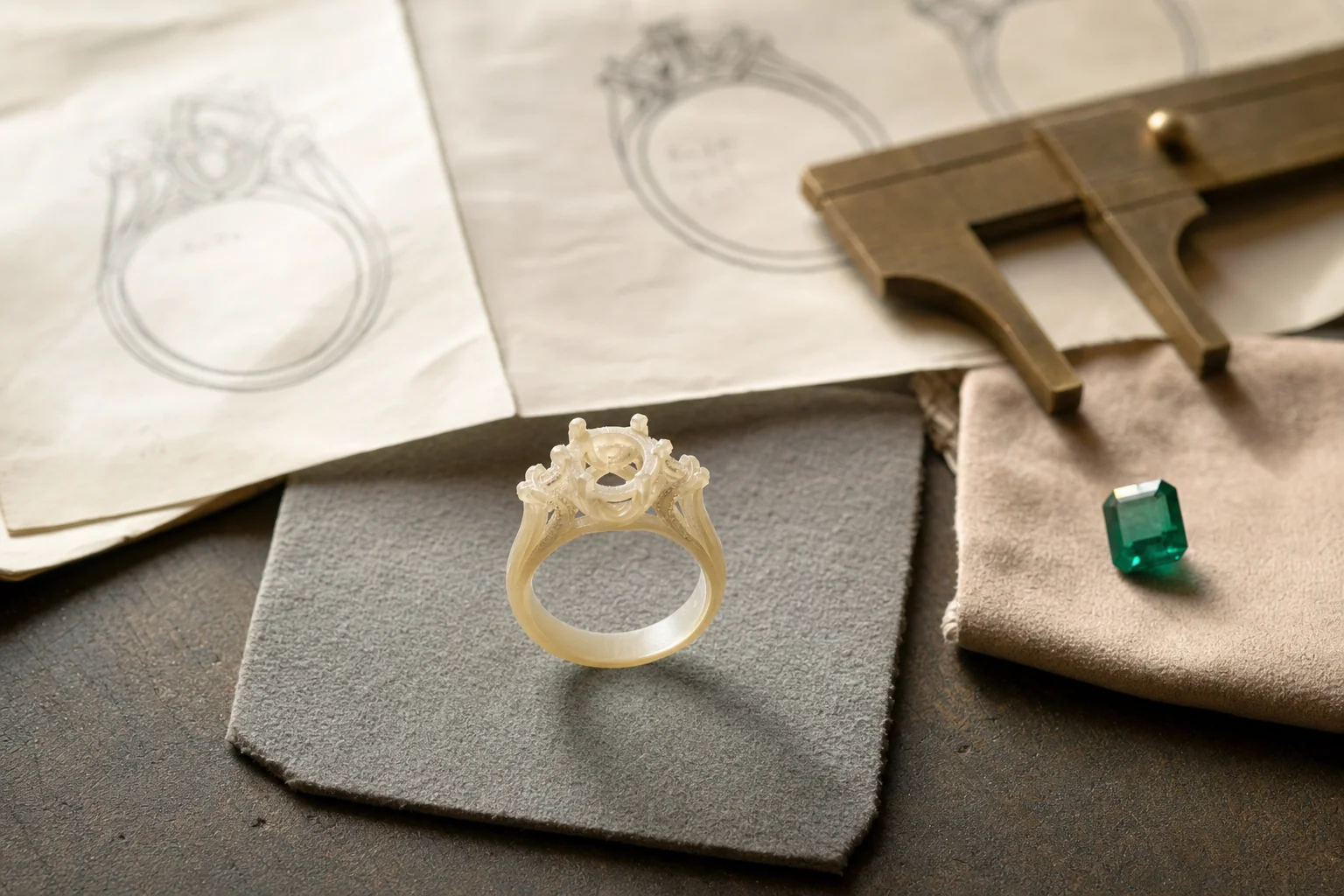
“Industry 4.0” is a phrase that can mean almost anything — it has been used to describe everything from cloud-computing supply chains to automated assembly lines. Inside a serious jewellery atelier, the term has a more specific meaning. It refers to a small set of digital and manufacturing technologies that, used carefully, have changed how an engagement ring moves from brief to finished piece. This article walks through what those technologies actually do inside the workflow, what they enable, and — critically — what they don’t change about the craft.
What Industry 4.0 means in jewellery
The framework, drawn from manufacturing more broadly, identifies four pillars of change:
- Digital design and modelling — precise computer-generated models of pieces before they exist physically.
- Additive manufacturing — the use of 3D printing for wax models and (increasingly) direct metal printing.
- Cyber-physical traceability — blockchain-backed provenance records and the ÊTRUNE ID system.
- Augmented and virtual reality — previewing pieces on the wearer’s hand before production begins.
Each of these has changed something measurable in how a serious atelier operates. None of them has changed the underlying craft of making a ring well.
Digital design and modelling
The starting point of any modern commission is a 3D model. The model is produced in specialised CAD software (Matrix, Rhinoceros with jewellery plugins, ZBrush for organic forms). The advantages over hand-drawn design are substantial:
Precise measurements. Every dimension is calibrated to the tenth of a millimetre. The seat for the centre stone matches the actual stone’s dimensions. The band fits the actual finger. The prong angles match the geometry of the stone’s pavilion.
Iteration speed. A change to the band width or the prong height can be made in minutes, not days. The wearer can review variations on the same call.
Documentation. The model itself becomes part of the ÊTRUNE ID record. The piece carries its own design DNA forward, available for future generations who may want to understand how it was made.
What this does NOT change is the design taste. A 3D modeller is a tool; the design judgement is human. A poorly-designed ring in CAD is still a poorly-designed ring. The atelier’s design sensibility is what makes the use of the tool worth anything.
Additive manufacturing (3D printing)
The most common use of 3D printing in modern jewellery is for wax models. The approved 3D model is printed as a high-resolution wax pattern, which is then used in the traditional lost-wax casting process. The wax model is more precise than hand-carved wax, faster to produce, and easier to iterate.
A smaller but growing application is direct metal printing — laser-sintered or binder-jetted precious metal that produces a near-final shape requiring less finishing. This is most practical for prototypes or for pieces with extremely intricate internal geometry; it is not yet competitive for fine engagement-ring production, where the metal density and surface quality of cast pieces remains superior.
The atelier still finishes by hand. The polishing, the setting, the final quality control — these remain manual processes. 3D printing accelerates the geometry; it does not replace the finishing craft.
Cyber-physical traceability: ÊTRUNE ID
The most substantive Industry 4.0 contribution to fine jewellery is the traceability layer. The ÊTRUNE ID system records every piece’s biography — design approval, materials, certifications, atelier interventions, ownership history — in a digital record that travels with the piece across decades.
The underlying technology stack varies. Some implementations use blockchain ledgers for tamper-evidence; others use signed database records with similar guarantees. The user-facing experience is the same: the wearer can verify, at any point, what materials are in their piece, what certifications back the gemstone, what services have been performed, and (for pre-owned pieces) what the chain of ownership looks like.
This is the most important change Industry 4.0 has produced for engagement rings specifically. The historical opacity of the trade — where a wearer trusted the jeweller because there was no other choice — has been replaced by a verifiable record. The trust now comes from the documentation, not just from the relationship.
Augmented and virtual reality
AR allows the wearer to see the proposed ring on their hand, at scale, in real lighting, before any physical work begins. The deeper discussion is in a separate piece, but the summary is: AR closes the gap between approval and reality. The piece that arrives is the piece that was already worn virtually.
VR — full immersive virtual environments — has a smaller role in current practice. Some ateliers use VR for the design review itself, letting the wearer “walk around” a model at large scale. The application is interesting but not yet essential to the production workflow.
What Industry 4.0 doesn’t change
The fundamentals of fine jewellery remain unchanged:
The gemstone. A certified Colombian emerald, a Madagascar sapphire, a no-heat ruby — these are natural objects with specific provenance, specific certification, and specific value. No digital technology produces or replaces them.
The metal craft. Casting, hand-finishing, setting, polishing — these are still hand processes performed by trained artisans. The wax may come from a printer, but the final piece passes through human hands.
The relationship. Engagement rings are commissioned with conversation. A wearer who only ever interacts with a CAD tool will get a worse ring than one who works with a designer who understands them.
The time. A serious commission still takes four to eight weeks. Industry 4.0 speeds up specific stages (especially iteration), but does not eliminate the time required for casting, setting, finishing, and certification.
How ÊTRUNE uses these tools
In our workflow:
- Every commission starts with a digital model. The model is reviewed by the wearer in 2D renders, then in AR on the hand, then approved.
- 3D printing produces the wax for lost-wax casting. The finished metal is hand-polished and hand-set.
- The piece’s biography is recorded in ÊTRUNE ID from the first design draft through the last +Care visit, decades later.
- AR preview is available for any wearer who wants it; it is not mandatory but increasingly chosen.
The technologies serve the commission. The commission serves the wearer.
What this means for the wearer
If you are commissioning an engagement ring in 2025, you should expect:
- A 3D model you can review before any physical work begins.
- AR preview if you ask for it.
- A complete certificate stack for the gemstone (origin, treatment, quality).
- An ÊTRUNE ID record (or equivalent from another reputable atelier) that travels with the piece across time.
- A timeline of four to eight weeks for the actual production, regardless of the digital tools used.
What you should NOT expect:
- Instant production. Industry 4.0 has not removed the time required for fine craft.
- Cheaper production. The technologies add precision and accountability; they do not necessarily reduce cost.
- Replacement of the wearer-atelier conversation. Tools support the conversation; they do not substitute for it.
A short reference
- Four pillars of Industry 4.0 in jewellery: digital design, additive manufacturing, traceability, AR/VR.
- What changes: precision, iteration speed, provenance documentation, design preview before production.
- What stays: gemstone reality, metal craft, atelier relationship, timeline.
- What ÊTRUNE commits to: documenting every piece in ÊTRUNE ID, supporting every piece with +Care, and serving every commission with the same craft discipline regardless of which tools accelerate which stages.
Industry 4.0 has made fine engagement rings more transparent, more iterative, and more accountable. It has not — and should not — replace the underlying craft.