
stories
Diamonds in Mythology and Folklore
Tears of gods, fragments of stars, tips of Cupid's arrows — a tour of what cultures have told themselves about the diamond, and why the romance has been so durable.
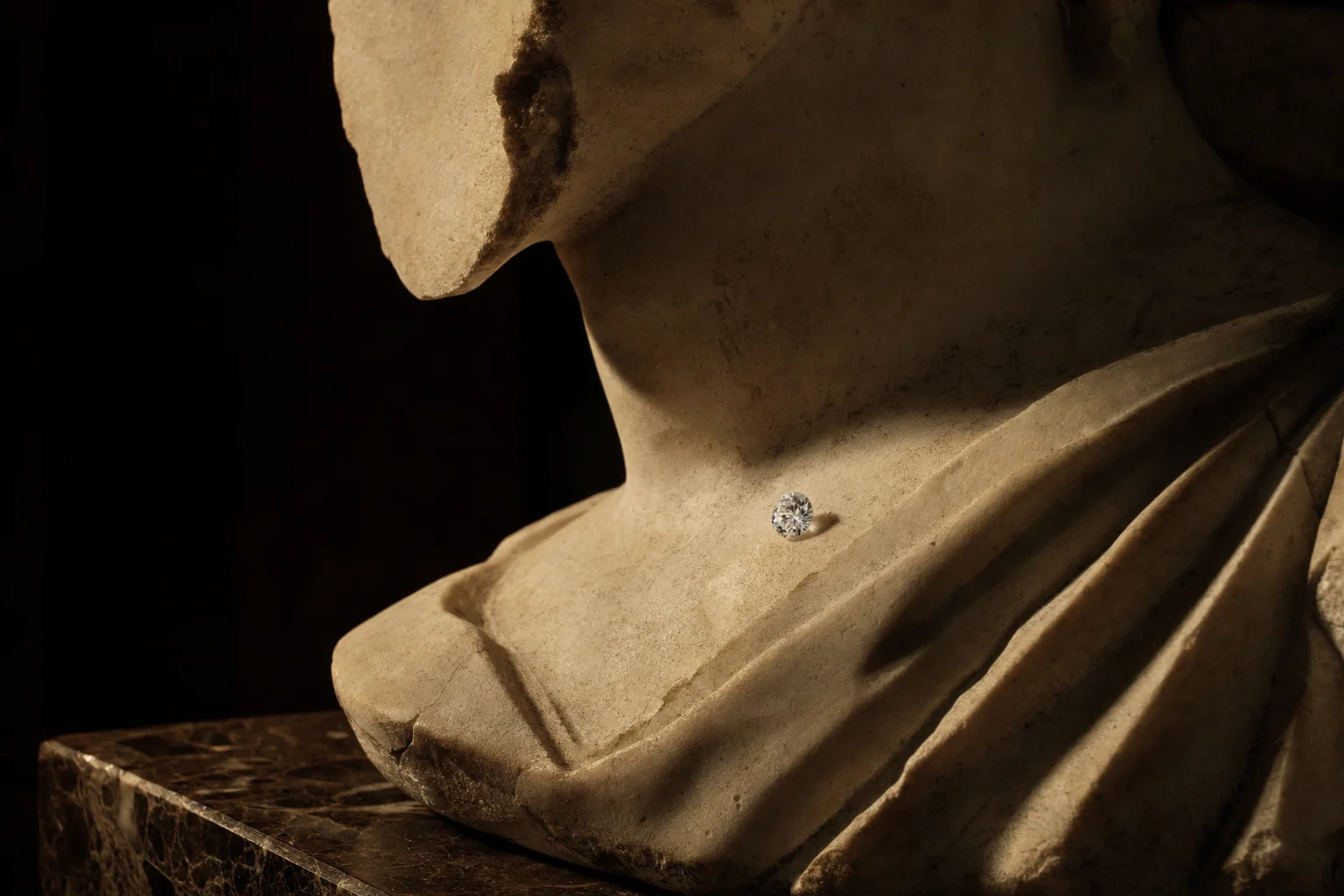
Long before there was a diamond grading scale, there were diamond stories. Cultures that knew the stone — and there were not many, for most of history, because India was the only meaningful source — spent centuries imagining where it came from. The imaginings were not random. They responded to what the stone actually does: it is hard, it is transparent, it returns light in a way no other material does, and it does not weather. From those four facts, every major diamond myth followed.
This piece is a tour of the recurring stories. It draws on Athena Perrakis’s The Crystal Lore, Legends & Myths, the classical sources (Pliny, Theophrastus), and the medieval European lapidaries that consolidated the tradition. None of it is offered as history of the stone itself — it is the history of what people thought the stone was.
India: lightning made solid
The earliest sustained tradition about the diamond is Vedic. The Sanskrit word for diamond, vajra, is also the word for the thunderbolt of Indra, the king of the gods. The two words are interchangeable in the Rig Veda: the thunderbolt and the diamond are the same thing in two different states. One is held by a god in the sky; the other is held by a human on the ground. The implication, in the texts, is that the diamond is what is left when lightning hits the earth and cools.
This origin story carried two consequences for how the diamond was treated. First, the stone was understood to be sacred — a divine residue rather than a geological accident. Diamonds were placed on the foreheads of god-images in Hindu temples, set into ceremonial weapons, and worn as protective amulets. Second, the stone was understood to be active — to carry, somehow, the force of the god whose weapon it was. Wearing a diamond was wearing a piece of Indra’s lightning.
The hardness of the stone reinforced both readings. Nothing scratched the diamond, and nothing was supposed to scratch the god. The Sanskrit literature treats this as a continuous proof rather than a metaphor: the diamond’s invulnerability is the god’s invulnerability, manifest in miniature.
Greece: tears of the gods
The Greeks knew diamonds only in small quantities and only as imports from India. What they made of the stone is, accordingly, more poetic and less ritualistic than the Vedic tradition. The recurring Greek motif is that diamonds are the tears of the gods — solidified moments of divine grief, fallen from the sky, retrieved by humans who happened upon them.
The motif is consistent with the optical reading. A diamond, viewed at the right angle, holds an internal play of light that the Greek eye read as moisture. The hardness made the tears imperishable; the transparency made them more refined than any human tear. Worn by a mortal, a diamond was a piece of divine emotion captured at the moment it crystallised.
The Greeks also developed the association between diamonds and Eros — the god of love, called Cupid by the Romans. The tradition appears in several sources: that Eros’s arrows were tipped with diamonds, and that a person struck by such an arrow would fall in love irreversibly. The arrow-tip image is gemologically apt — diamond is the only material hard enough to be made into a sharp, durable point — and it tied the stone to romance early enough that the medieval European tradition could simply inherit the association.
Rome: courage in battle, reconciliation in love
The Roman tradition combined the Indian and Greek strands and added a practical one. Roman writers — Pliny most thoroughly, in the Natural History of the first century — described diamond as the hardest of all stones and recommended it to soldiers as protection in combat. A diamond worn on the body, the texts argued, would deflect blows and turn aside iron weapons. Pliny himself acknowledged that he had not tested the claim.
In parallel, the Roman tradition kept and elaborated the Eros association. Diamonds were considered effective at reconciling quarrelling lovers. The reasoning was poetic: the purity of the stone was thought to restore the purity of the bond between two people who had argued, and the hardness of the stone was thought to remind them that the bond itself was not so easily broken. The practice of giving a diamond to a partner after a serious argument has its roots in this Roman tradition, although it has fallen out of use.
The Roman texts also introduced the durability argument that would dominate European thinking for the next two thousand years: that the diamond was a fitting symbol of love because, like love at its best, it could not be destroyed. The argument is not strictly accurate — diamonds can be shattered along their cleavage planes — but as a metaphor it has outlasted almost every other.
Medieval Europe: the king of gems
By the Middle Ages, the diamond had become firmly established in European royal jewellery as the king of gems. The phrase appears in the thirteenth-century lapidary of Albertus Magnus and recurs in court inventories across the next four centuries. Diamonds were given on betrothal among the nobility, exchanged at coronations, and embedded in the regalia that symbolised legitimate authority.
The medieval lapidary tradition added a layer of marriage-specific folklore. A diamond was said to strengthen the loyalty of a married couple, to detect infidelity (the stone was thought to dim in the presence of an unfaithful partner), and to protect against external threats to the marriage — political enemies, slander, the evil eye. The 1477 betrothal of Mary of Burgundy to Archduke Maximilian of Austria — the first documented diamond engagement ring — is usually treated as the formal start of the modern tradition, but the cultural ground was prepared for centuries.
The medieval tradition also developed the cursed diamond narrative — the idea that certain famous diamonds carried misfortune to anyone who possessed them. The Koh-i-Noor, the Hope, the Sancy, and several others accumulated genealogies of misadventure that follow them into modern museum catalogues. We discuss the Koh-i-Noor in The Most Important Diamond in History. The curse narrative is not innocent — it served the political purposes of the courts that lost the stones, which preferred to frame the loss as supernatural rather than as a function of conquest.
What the myths have in common
The four traditions — Vedic, Greek, Roman, medieval European — converge on a small set of meanings that have remained legible into the present:
- The diamond is from elsewhere. Whether thunderbolt, divine tear, fragment of star, or solidified force, the stone is consistently figured as having an extra-terrestrial or extra-mundane origin. It is not of the ordinary world.
- The diamond is invulnerable. The hardness is read as a virtue: durability, fidelity, protection, resilience.
- The diamond witnesses. Whether it dims at infidelity, glows at love, or amplifies the wearer’s resolve, the stone is consistently figured as a participant in the wearer’s life, not just an ornament on it.
- The diamond binds. From the Eros arrow to the medieval betrothal ring to the modern engagement, the diamond’s most stable use is to mark and reinforce a bond between two people.
These four meanings have been so durable across cultures that they survive even now, even after the gemological tradition has stripped away most of the supernatural claims. A modern wearer who calls a diamond forever is, in a real sense, repeating Vedic, Greek, Roman, and medieval traditions in a single English word. The story is older than the gemology, and the gemology has not displaced it.
A short reference
- India: diamond = thunderbolt = invulnerability. The original tradition.
- Greece: diamond = tears of the gods, tipped Eros’s arrows. The origin of the romance association.
- Rome: diamond protected in battle and reconciled lovers. The first explicit pairing with love.
- Medieval Europe: “king of gems,” used at royal betrothals, with a parallel curse tradition.
- What persists: otherworldly origin, invulnerability, witnessing presence, binding power.
A diamond, worn today, carries every one of these stories — whether the wearer knows it or not.