
stories
The Influence of Emeralds on Zodiac Signs
A measured look at how astrological traditions have associated emerald with specific signs — and what the gem actually does for the wearer beyond the mythology.
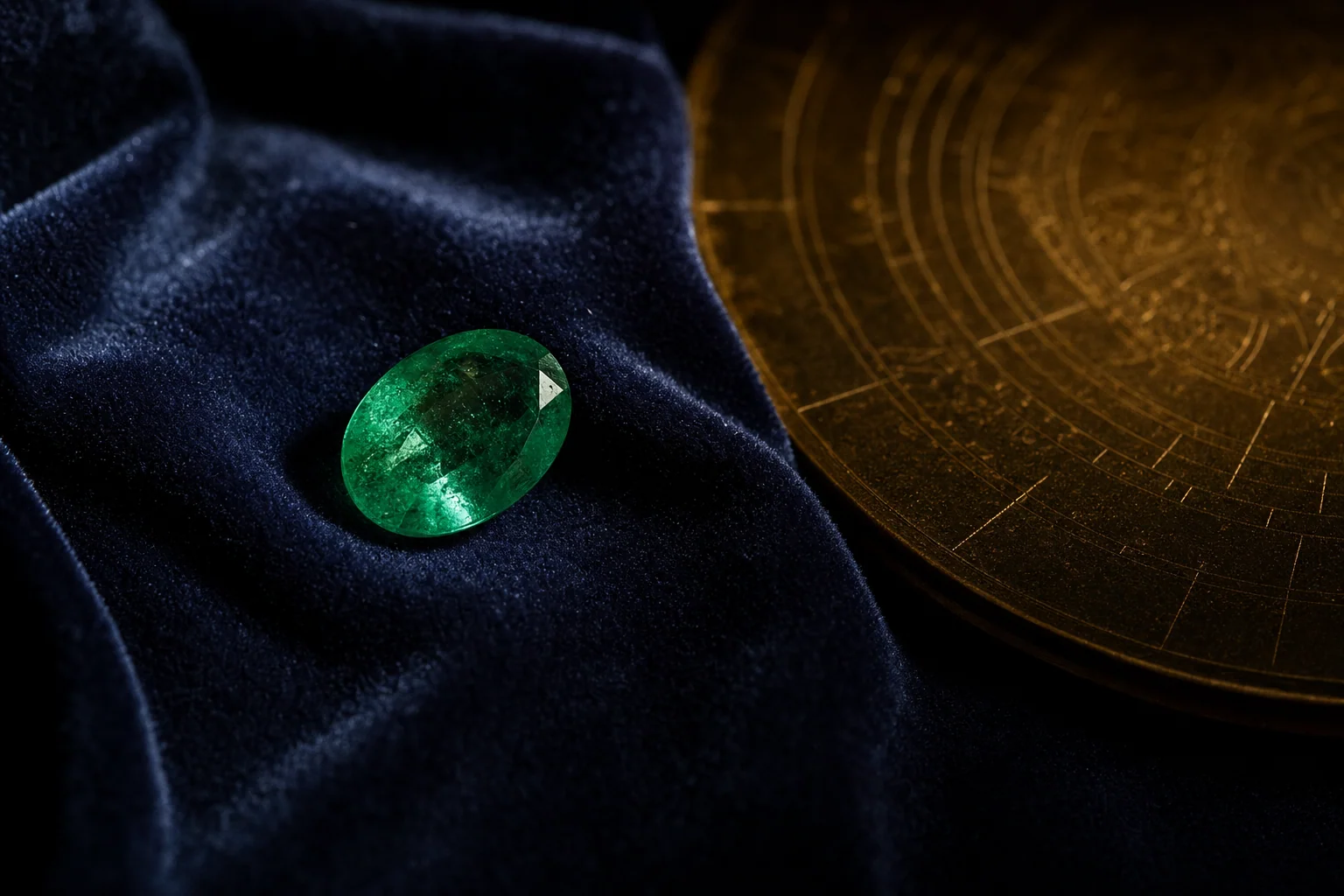
Across nearly every tradition that has worked with gemstones — Vedic astrology, classical Western astrology, medieval European lapidaries, modern New Age — emerald has been assigned meaning. It is the May birthstone in the standardised modern list. It is associated specifically with Taurus and Cancer in Western astrology, with Mercury in Vedic astrology. It has been called the stone of the heart, the stone of communication, the stone of patient growth. This piece looks at the associations carefully, without dismissing them and without overclaiming what they actually do.
The classical associations
Emerald’s astrological lineage is among the most consistent of any gemstone. The reasons are partly material — the green of emerald is unmistakably the green of new vegetation, of fertility, of renewal — and partly historical. The Egyptians associated emerald with Isis. Roman writers, particularly Pliny the Elder in Natural History, recorded the gem as soothing to tired eyes (a belief that survived into medieval Europe). The early Christian tradition placed emerald among the foundation stones of the New Jerusalem in the Book of Revelation.
These associations cemented during the medieval lapidary tradition. The De Lapidibus of Marbode of Rennes (eleventh century) attributes to emerald the power to fortify the eyes, calm the spirit, and reveal truth in speech. By the time the tradition reached the early modern period, emerald was firmly associated with the planet Mercury (communication, intellect, healing) and with the springtime months of late April and May.
Why Taurus and Cancer
In the Western zodiac, emerald is associated with Taurus (April 20 – May 20) primarily through the May birthstone tradition. The association is straightforward: a Taurus celebrating a birthday in May will likely receive an emerald-related gift, and the symbolic resonance between Taurus’s earth-sign qualities (groundedness, patient growth, sensual appreciation) and emerald’s traditional meaning (renewal, fertility, calm green) has reinforced the link.
The association with Cancer (June 21 – July 22) is less commercial and more interpretive. Cancer is a water sign, associated with emotion, intuition, and the heart. Emerald has been historically called the “stone of the heart” in many traditions — partly because of its colour, partly because of its association with successful love (more on this in the emerald-as-symbol-of-love piece). For Cancer specifically, emerald is recommended as a stone that supports emotional steadiness and clear communication of feeling.
Some traditions also link emerald to Virgo, Libra and Aquarius, but with less consistency. The Taurus and Cancer associations are the durable ones.
The Vedic tradition
Vedic astrology — the Indian astrological system — assigns emerald to Mercury (Budha) and recommends it for those born under Gemini and Virgo, the two signs Mercury rules. The Vedic tradition is more specific than the Western one about how a stone should be worn: emerald should be at least one carat, set in gold, worn on the little finger, and astrologically activated through a specific ritual sequence.
The Vedic tradition has been more durable than the Western one in its prescriptive specificity. A Vedic astrologer recommending emerald will give the wearer concrete parameters — date and time to begin wearing, side of the body, weight of stone, type of metal — based on the wearer’s natal chart. The recommendation is not generic; it is calibrated to the individual.
This level of specificity makes Vedic astrology a more demanding system, and it explains why fine emerald has had such consistent commercial demand in India for centuries.
What the stone does, materially
If you set aside the symbolic and astrological associations, emerald as a physical object does several things that any wearer can verify:
It is a beryl, hardness 7.5–8 on the Mohs scale — hard enough to survive daily wear with care, soft enough to require avoiding hard impacts. It is brittle, with characteristic surface-reaching fractures (called “jardin” in the trade, “garden” because they resemble plant growth) that are normal and frequently filled with cedar oil or resin to improve appearance.
The colour green that emerald produces is one of the most psychologically restful colours in the visible spectrum. The eye relaxes when looking at a saturated, well-lit emerald in a way it does not relax when looking at a deep red or a brilliant yellow. Pliny the Elder’s observation that emerald soothes tired eyes is, on this point, not mystical — it is straightforward optics and neurology.
When set in a piece of jewellery, emerald carries a different visual register than diamond. It is more contemplative, less brilliant, more about depth than fire. It rewards careful looking, and it ages well aesthetically as the wearer ages — a saturated green never reads as juvenile, never reads as dated.
How wearers approach emerald in practice
Setting aside both the astrological prescription and the strict materialism, most contemporary wearers approach emerald with a layered intention:
The colour appeals. The wearer simply likes the green. This is the most common entry point, and it is sufficient.
The symbolism resonates. The wearer is drawn to emerald’s classical associations with growth, communication, the heart, or springtime renewal. This is a soft motivation but a real one.
The birth association applies. The wearer is born in May, or under Taurus, or under Gemini in the Vedic system, and the birthstone or astrological tradition is part of the choice.
The provenance interests. The wearer is drawn to Colombian emerald specifically because of the long trade history, or to a smaller-producer origin (Brazil, Zambia, Ethiopia) for its own reasons.
These motivations overlap. Most wearers carry two or three of them simultaneously. The maison does not need to interrogate which is dominant.
What ÊTRUNE does with emerald
When a commission is built around an emerald centre stone — for an engagement ring, a heritage piece, a personal commission — we treat the gemstone as a gemstone: with full certification, transparent treatment disclosure, careful setting that protects the stone’s natural fragility, and a +Care program calibrated to emerald’s particular sensitivities (no ultrasonic cleaning, careful re-oiling at recommended intervals).
The astrological and symbolic associations the wearer brings to the stone are their own. We respect them and do not press for or against them. What we ensure is that the physical object lives up to whatever meaning the wearer has invested in it.
A short reference
- May birthstone in the standardised modern list.
- Western astrology: Taurus (primarily), Cancer (interpretively), sometimes Virgo/Libra/Aquarius.
- Vedic astrology: Mercury’s stone, recommended for Gemini and Virgo, with specific prescriptive parameters.
- Historical associations: sight, heart, communication, springtime renewal, fertility.
- Material reality: beryl, 7.5–8 Mohs hardness, characteristic jardin, almost always oil-treated.
The wearer brings the meaning. The atelier ensures the stone deserves it.