
history
The Most Important Diamond in History
The Koh-i-Noor — a diamond that has moved across empires for seven hundred years, carrying conquest, mythology, and a question of ownership that remains unresolved.
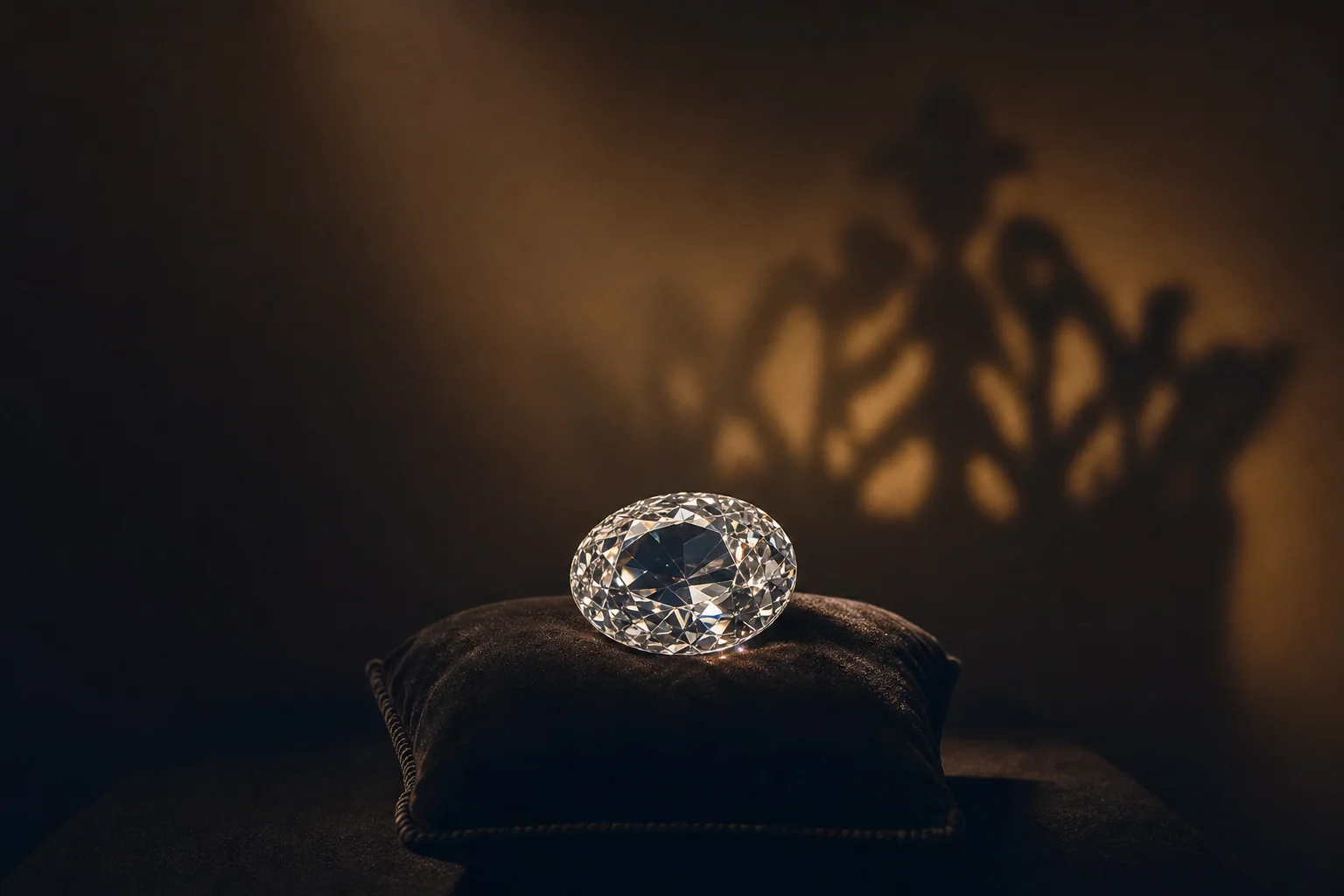
There are larger diamonds. There are clearer diamonds. There are diamonds with finer cut, with better fluorescence, with more impressive provenance from a gemological standpoint. There is no diamond, however, that carries the weight of history that the Koh-i-Noor does. Mountain of Light in Persian. A stone that has been worn by Mughal emperors, Persian shahs, Afghan kings, Sikh maharajas, and the British monarchy. A stone that India, Pakistan, Afghanistan, and Iran have each formally requested be returned. A stone that has been at the centre of a diplomatic and ethical conversation for nearly two centuries without resolution.
This article walks through the diamond’s seven-century journey and the questions it raises. It is not a buying guide. It is a study in what happens when a single physical object accumulates more history than any one country can hold.
The Golconda origin
The Koh-i-Noor was almost certainly mined in the alluvial diamond fields of the Krishna River, in the kingdom of Golconda in south India. The dating is uncertain — the stone may have entered the historical record as early as the thirteenth century — but Golconda is the only source consistent with its physical characteristics. The Golconda diamonds are Type IIa: pure carbon, no nitrogen, no boron, characteristically high transparency. Almost every diamond of historic importance from before the eighteenth century — the Hope, the Regent, the Orlov, the Idol’s Eye — is also Golconda Type IIa.
The stone’s earliest verifiable mention is in the Mughal court records of the seventeenth century. By the time the Mughal emperor Shah Jahan commissioned the Peacock Throne in the 1630s, the diamond was already part of his imperial regalia. The Peacock Throne — covered in 230 kilograms of gold, set with rubies, emeralds, and diamonds, with the Koh-i-Noor as a centrepiece — was one of the most extravagant single objects ever made. It took seven years to construct and was valued, at the time, at twice the cost of the Taj Mahal.
The first conquest: Nader Shah, 1739
In 1739, the Persian ruler Nader Shah invaded the Mughal Empire, sacked Delhi, and looted the imperial treasury. The Peacock Throne was carried back to Persia. Tradition holds that the Mughal emperor Muhammad Shah, attempting to hide the diamond, kept it concealed in his turban during negotiations. Nader Shah, learning of the trick, proposed the customary exchange of turbans as a gesture of friendship — and so acquired the stone. On unwrapping it, he is said to have exclaimed Koh-i-Noor! — Mountain of Light — and the name has stayed.
After Nader Shah’s assassination in 1747, the diamond passed to the Durrani Empire in Afghanistan, where it remained for the next seventy years. In 1813, the Afghan ruler Shuja Shah Durrani, in exile and seeking restoration to his throne, gave the Koh-i-Noor to Maharaja Ranjit Singh of the Sikh Empire in exchange for military support. The maharaja became the diamond’s next custodian, and the Sikh court the next setting for the stone.
The second conquest: the British, 1849
In 1849, after the Second Anglo-Sikh War, the British East India Company annexed the Punjab. The Treaty of Lahore, signed under duress by the ten-year-old Maharaja Duleep Singh, the last ruler of the Sikh Empire, required the surrender of the Koh-i-Noor to Queen Victoria of the United Kingdom. The stone was shipped from Lahore to London, where it arrived in 1850.
Queen Victoria’s initial reaction to the diamond was disappointment. The Mughal-era cutting was rose-style — a domed crown of triangular facets, optimised for the lighting of an open court rather than for modern electric illumination. The stone read as dull under European viewing conditions. In 1852, Prince Albert commissioned the diamond to be recut by Dutch cutters as a modern oval brilliant, and the original 186-carat stone was reduced to 105.6 carats. The recut increased the brilliance significantly; it also destroyed approximately 43% of the original mass.
The historic loss of mass is one of several reasons the recut is often criticised, both by gemologists and by the cultures of origin. The original cut was a piece of Mughal craft history. The recut is a piece of Victorian craft history.
The British setting
Since 1937, the Koh-i-Noor has been set in the Crown of Queen Elizabeth, the Queen Mother, where it remains today. The Crown is part of the Crown Jewels held in the Jewel House at the Tower of London, on display to roughly two and a half million visitors per year. The stone has appeared in coronation regalia only three times since reaching Britain: at the coronations of Queen Mary in 1911, of Queen Elizabeth (the Queen Mother) in 1937, and was on the crown placed on the coffin at Queen Elizabeth II’s lying-in-state in 2022.
The placement of the diamond in the Queen Consort’s crown rather than in the Sovereign’s crown is, in some readings, a response to the legend of the Koh-i-Noor’s curse: that any male ruler who possessed the stone would meet misfortune, while female rulers would prosper. Whether this is the actual reason or a post-hoc rationalisation is unclear.
The question of return
India formally requested the return of the Koh-i-Noor in 1947, immediately upon independence. The request has been repeated multiple times since, including formally in 1953, 1976, and 2016. Pakistan has also requested the stone, on the basis that Punjab — the territory from which it was taken — is now split between India and Pakistan. Afghanistan has made claims via the Durrani lineage. Iran has made claims via Nader Shah’s conquest.
The British government’s position has been consistent: the stone was acquired legally under the Treaty of Lahore and will not be returned. The legal position is technically defensible. The ethical position is more difficult: the Treaty of Lahore was signed by a child under military occupation, on behalf of an empire that no longer existed and a state that had been forcibly dissolved. The international conversation around the return of looted cultural artefacts has shifted significantly in the twenty-first century, with the return of artefacts from European museums to Benin, Greece, Egypt, and others. The Koh-i-Noor remains one of the most prominent objects to which the conversation has not yet extended.
What the Koh-i-Noor teaches
The diamond’s history is, in one reading, the history of how high-value cultural objects move across empires — by gift, by tribute, by negotiation, by conquest, by treaty. The Koh-i-Noor has been transferred by every one of these mechanisms across its known history. Each transfer is documented; each transfer is contested in some way.
The diamond is also a reminder that provenance is not optional. A modern wearer of a high-value stone has a moral as well as a practical interest in knowing the chain of custody. The questions raised by the Koh-i-Noor — by whom, from whom, under what conditions, with what consent — are the questions that any serious atelier asks of every stone it sets. The answers, for an ÊTRUNE piece, are recorded in ÊTRUNE ID. The answers, for stones with longer histories, are sometimes the work of generations of researchers.
The Mountain of Light, for now, remains in the Tower of London. The diamond itself — the carbon lattice, the optical properties — has not changed since the seventeenth century. What has changed, repeatedly, is what the stone is taken to mean.
A short reference
- Origin: Golconda alluvial fields, southern India. Type IIa diamond.
- Mughal era: centrepiece of Shah Jahan’s Peacock Throne.
- 1739: Nader Shah of Persia takes the stone in the sack of Delhi.
- 1813: Passes to the Sikh Empire under Maharaja Ranjit Singh.
- 1849-1850: Surrendered to the British under the Treaty of Lahore.
- 1852: Recut from 186 to 105.6 carats by Dutch cutters in London.
- Today: Set in the Crown of Queen Elizabeth, the Queen Mother, on display at the Tower of London.
- The unresolved question: India, Pakistan, Afghanistan, and Iran have all formally requested return.
A single stone, seven centuries, the question still open. The Koh-i-Noor is not the largest diamond. It is, by every other measure, the most important.