
gemstones
Understanding Corundum
One species, two gem varieties, and a hardness second only to diamond — how ruby and sapphire are the same mineral, and what the trace chemistry decides about which is which.
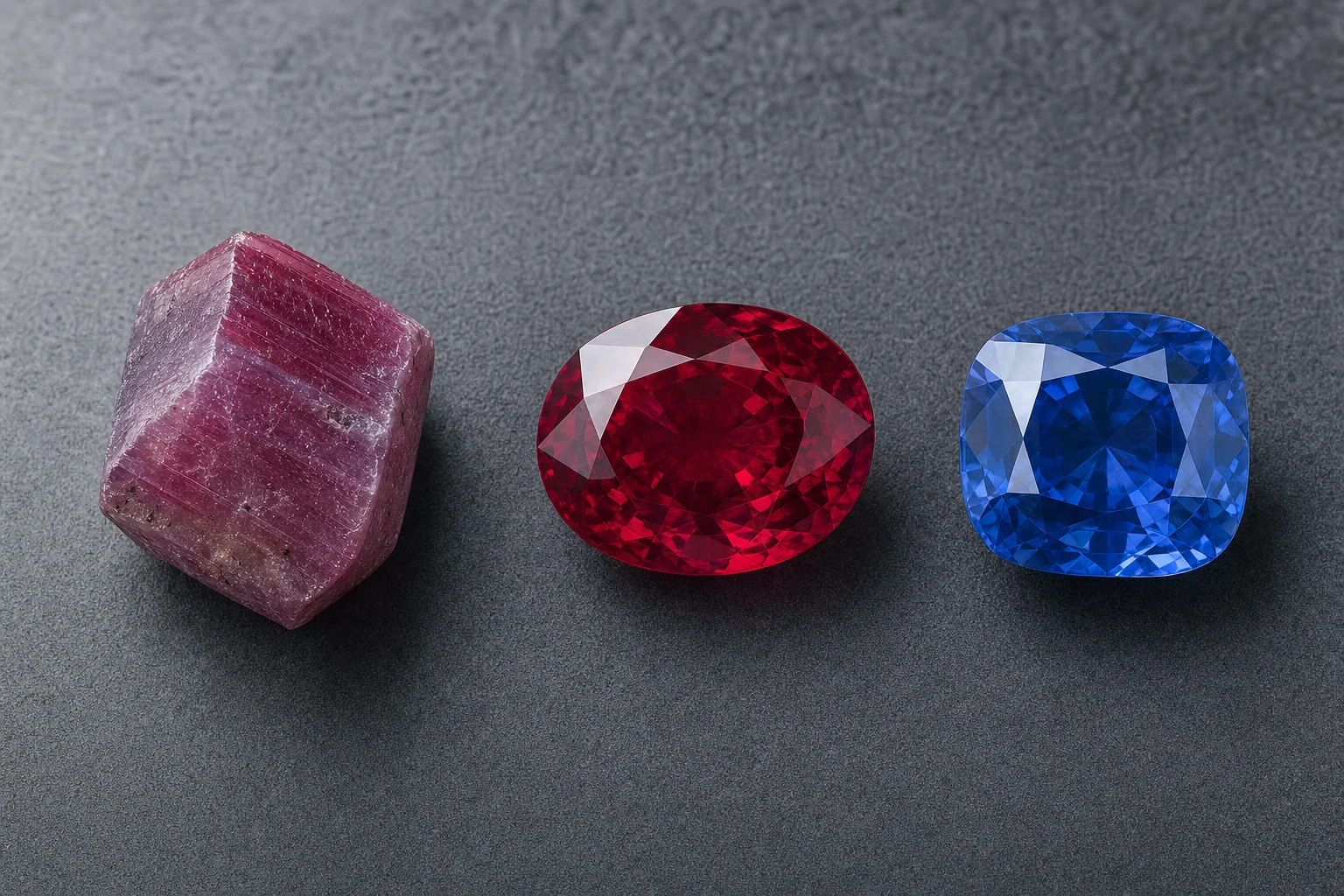
There is a quiet surprise at the heart of fine gemstones: the ruby and the sapphire, two of the most distinct-looking gems in the trade, are the same mineral. Both are corundum — aluminium oxide, chemical formula Al₂O₃ — separated only by which trace element happens to be present in the lattice. A trace of chromium, and the stone is a ruby. A trace of iron and titanium, and the stone is a blue sapphire. Vanadium, the stone is a violet sapphire. Almost any other element in the right concentration, the stone is one of the fancy sapphire colours.
This article is an introduction to corundum as a species — what it is, where it forms, what makes it valuable, and how the two famous varieties relate to each other and to the broader family of fancy sapphires. It is the second-hardest natural mineral after diamond, and the second most important coloured-stone family in fine jewellery (after the beryl family, which contains emerald). Understanding corundum is, in many ways, where serious gemology begins.
The chemistry, briefly
Corundum is a simple chemical: two aluminium atoms and three oxygen atoms, arranged in a tightly packed hexagonal (trigonal) crystal lattice. Pure corundum is colourless. Almost no corundum in nature is pure; the lattice readily accepts substitutional trace elements where one of the aluminium atoms ought to sit.
The major colour-producing substitutions:
Chromium (Cr³⁺) — produces red. As little as 0.1% chromium replacing aluminium is enough to shift the stone from colourless to vivid red. The result is ruby. The same chromium that colours rubies also colours emeralds — different host minerals, same colorant.
Iron and titanium (Fe²⁺ + Ti⁴⁺) — together, via a process called intervalence charge transfer, produce blue. Either element alone produces only a weak yellowish or pale tint; combined, they create the deep blue of fine sapphire.
Iron alone (Fe³⁺) — produces yellow. Yellow sapphires are common in the trade and span from pale buttery tints to vivid canary yellow at the rare end.
Vanadium (V³⁺) — produces violet. Combined with traces of chromium and iron, it can produce the colour-change sapphires of Sri Lanka, which read as blue in daylight and as violet-purple under incandescent light.
Chromium + iron in unusual ratios — produces orange-pink. This is the rare padparadscha sapphire — the most coveted of all sapphire colours, named after the lotus blossom that gives it its name.
The trade convention — and it is, gemologically, slightly arbitrary — is that red corundum is called ruby and every other colour of corundum is called sapphire. A pink corundum is a pink sapphire, not a pale ruby. The line between deep pink sapphire and pale ruby is a subject of ongoing professional debate; the laboratories that grade these stones generally draw the line by saturation rather than hue.
Hardness and toughness
Corundum sits at 9 on the Mohs scale, second only to diamond at 10. This makes it the second-hardest natural gemstone and, more importantly, one of only a handful of gem materials genuinely durable enough for daily wear in a ring on the most-used hand of the body. A sapphire engagement ring worn daily for fifty years will arrive at the other side of the half-century without significant abrasion. An emerald, by comparison, is softer and more brittle and will require careful handling and periodic recutting.
Corundum has no cleavage. This is a separate property from hardness and a separate kind of durability: even when struck along a specific plane, the stone does not split along it. Diamonds, despite their higher hardness, can be cleaved with a precise blow because of their octahedral cleavage. Corundum cannot. This combination — high hardness plus no cleavage — makes corundum the most physically reliable of the major gem species for daily wear.
How and where corundum forms
Corundum forms in a few distinct geological environments:
Metamorphic. When aluminium-rich rocks (especially marbles formed from impure limestones) are subjected to heat and pressure, corundum can crystallise out as the rock recrystallises. Many of the world’s finest rubies come from this kind of deposit: Mogok in Myanmar, Mong Hsu (also Myanmar), the Hunza Valley in Pakistan, and certain Tanzanian and Mozambican deposits.
Igneous. Corundum can also crystallise from cooling silica-poor magmas, particularly basalts. Sapphires from Australia and Thailand are typically of igneous origin. The igneous sapphires are often darker and contain more iron than the metamorphic ones, which is why the trade has historically preferred Kashmir, Burma, and Ceylon sapphires (all metamorphic) for the finest blues.
Alluvial. Once corundum has crystallised, its hardness means that it survives weathering of the surrounding rock and concentrates in stream gravels. Most commercial corundum mining is alluvial — the stones are recovered by sifting riverbed gravels rather than by hard-rock extraction. The Ratnapura district in Sri Lanka, the gem gravels of Madagascar, the Songea region in Tanzania, and the Pailin region in Cambodia are all alluvial fields.
Major sources, and what they mean
Origin matters enormously in the corundum market. The same hue from different sources can differ in price by a factor of three to ten, because the trade has built up centuries of preference for certain origins:
Burmese (Myanmar) rubies — the pigeon-blood standard. The finest rubies in history come from the Mogok region, characterised by a deep, vivid, slightly fluorescent red that no other source quite matches.
Kashmir sapphires — the velvety cornflower-blue standard. Mined only briefly in the late nineteenth century from a single high-altitude deposit. Truly Kashmir-origin stones are extremely rare in the modern market and command extreme prices.
Burmese sapphires — royal blue, occasionally rivalling Kashmir.
Ceylon (Sri Lanka) sapphires — typically a lighter, brilliant cornflower or sky-blue. The most commercially important sapphire source today.
Madagascar sapphires — emerging as a major source since the 1990s, producing fine cornflower blues that sometimes match Sri Lankan stones at lower price points.
Padparadscha sapphires — primarily from Sri Lanka, occasionally from Madagascar. The orange-pink colour is the most coveted in the fancy sapphire spectrum.
A laboratory report from SSEF, Gübelin, or AGL stating the origin of a sapphire is often the most economically significant single document associated with the stone. We discuss why in the certification stack.
Two optical curiosities
Corundum displays two optical phenomena that are worth flagging because they appear in the trade and confuse buyers who do not know to look for them.
Asterism — the six-rayed star that appears across the dome of certain cabochon-cut rubies and sapphires. The star is produced by reflections off three sets of parallel rutile-needle inclusions oriented at 60° to each other. When the cabochon is properly oriented, the three sets of reflections converge into a six-pointed star that appears to float on the surface as the stone moves. We discuss the spiritual associations in The Spiritual Character of Sapphires.
Pleochroism — different colours when viewed from different angles. Corundum is pleochroic: a single stone can show two distinct shades depending on the viewing direction. A blue sapphire might show a slightly violet hue along one optical axis and a more neutral blue along the other. The cutter’s job is to orient the stone so that the better colour is presented face-up.
A short reference
- What it is: aluminium oxide, Al₂O₃, hardness 9, no cleavage.
- The two famous varieties: ruby (chromium = red) and sapphire (everything else).
- Colour chemistry: chromium for red, iron+titanium for blue, iron alone for yellow, vanadium for violet, mixed chromium+iron for padparadscha pink-orange.
- Major sources: Myanmar (Mogok), Kashmir, Sri Lanka, Madagascar, Tanzania, Mozambique.
- Optical curiosities: asterism (star sapphires/rubies), pleochroism.
- Why it matters for daily wear: second hardest natural gem and one of the few with no cleavage.
Corundum is the gem the trade chooses when it wants something to last fifty years on a daily-worn hand. The chemistry is simple. The varieties are dazzling.