
stories
The Spiritual Character of Sapphires
What the metaphysical literature reads into the blue corundum — wisdom, truth, calm, loyalty — and how the asterism star above a cabochon has been understood as a small map of the soul.
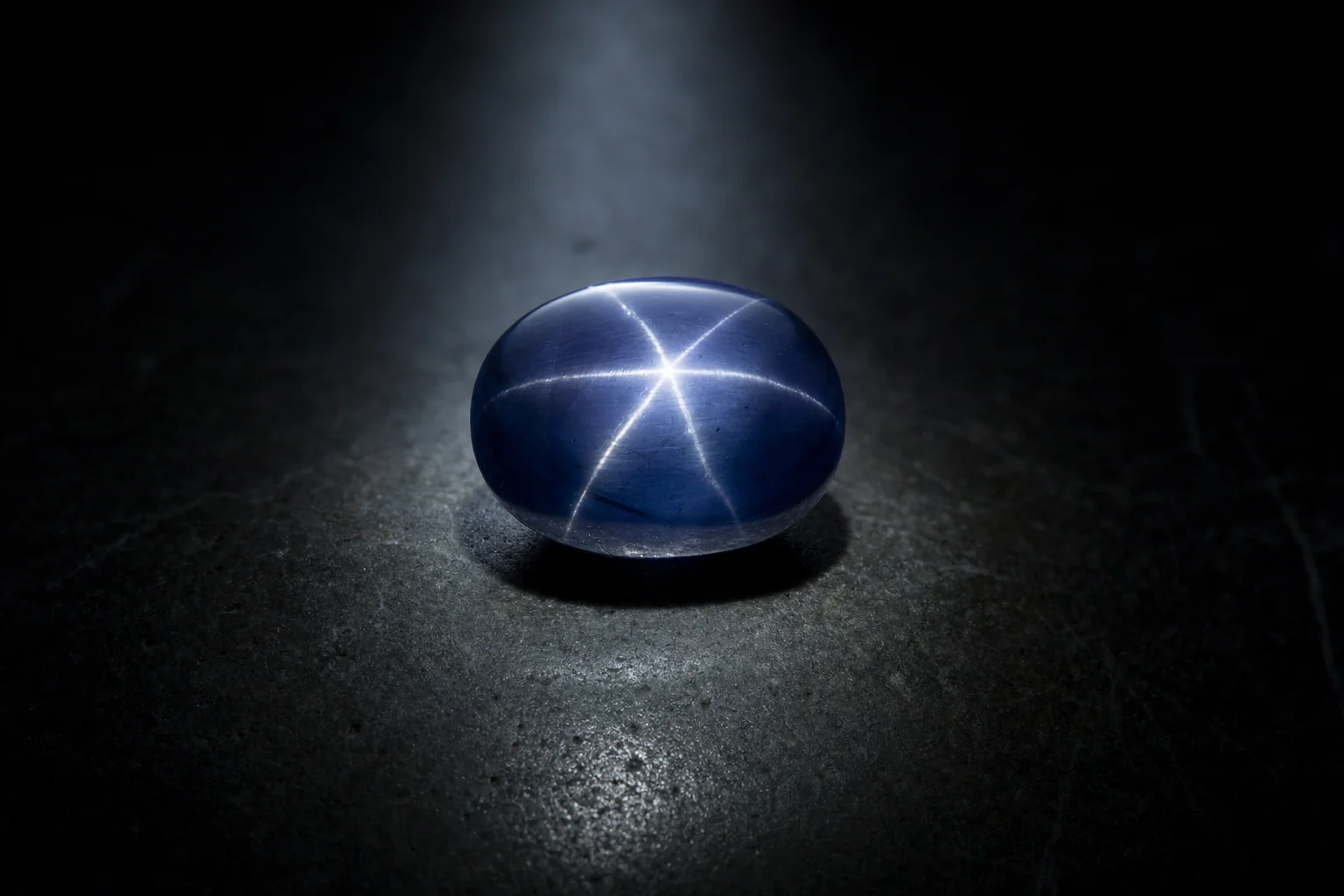
If the diamond is the gem of clarity, the sapphire is the gem of wisdom. The distinction has been remarkably stable across the metaphysical literature: where the diamond illuminates and amplifies, the sapphire steadies and deepens. The same blue corundum that the medieval church gave to bishops, the same stone that the Buddhist tradition associated with meditative insight, the same gem that modern metaphysical writers describe as supporting truth and loyalty — all of these are reading the same physical object in remarkably consistent terms.
This piece draws on The Book of Stones by Robert Simmons and Naisha Ahsian as a primary reference, alongside the older European lapidary tradition and the contemporary writing on crystal-and-energy work. As with the comparable piece on diamond, we are not making medical claims for the stone. We are describing what the tradition asserts and why, optically and culturally, the assertions hold together.
The four core associations
Across the literature, four qualities recur when sapphire is described in symbolic terms.
Wisdom. Sapphire is the stone most consistently associated with the higher mind — with the kind of thinking that sees past surface concerns to underlying patterns. The association predates the metaphysical literature: medieval European bishops wore sapphire rings precisely because the stone was understood to support sound judgement, and the Greek and Persian sources before them assigned the same quality to the gem.
Truth. Sapphire has been called the truth stone in nearly every tradition that knows it. Worn during difficult conversations, the stone is said to make honesty easier — both speaking it and recognising it. The medieval lapidaries claimed that sapphires would crack in the presence of a lie; the modern metaphysical literature is less literal but makes the same point. A sapphire wearer is, in the tradition, harder to deceive and harder to be dishonest in front of.
Loyalty. This is the betrothal association, and it is what made the sapphire one of the original engagement-ring stones in the medieval European courts (predating the diamond engagement ring by centuries). Sapphire is said to deepen commitment — to support the long-horizon faithfulness that any sustained partnership requires. The gift of a sapphire, in this reading, is the gift of a witness to the bond.
Calm. Where diamond amplifies, sapphire stabilises. The stone is said to settle anxious states, to clear mental fog, to slow racing thoughts enough that the actual problem becomes visible. The colour itself — deep blue, the colour of sky and deep water — is associated cross-culturally with calm; the metaphysical tradition extends this from a visual association into a felt one.
Chakra and elemental associations
In the chakra system, sapphire is most strongly associated with the third eye chakra — the energy centre between the eyebrows, governing intuition, perception, and inner sight. The pairing is consistent with the wisdom and truth associations: a stone of clear seeing matched to the chakra of vision.
A secondary association links sapphire to the throat chakra — the energy centre governing communication, voice, and the speaking of one’s truth. The pairing extends the truth association into the speaking of it, not just the recognising of it. The metaphysical literature describes the sapphire as supporting clear communication, particularly the kind of communication that has felt blocked or compromised.
Elementally, sapphire is most often classified with water — the element of intuition, depth, and emotional movement. The pairing is intuitive: the deep blue, the calm, the inwardness. A few traditions classify the yellow sapphire separately, under fire (because yellow), and the colour-change sapphires under air (because they shift); these are minor variants of the main classification.
Asterism — the star as a map
A particular subset of sapphires — and rubies — exhibit asterism, the six-rayed silver star that appears across the dome of a properly oriented cabochon. The phenomenon is optical: oriented rutile-needle inclusions, perpendicular to the crystal’s c-axis in three sets, reflect light in three intersecting lines that meet at a single point. The star appears to float on the surface of the stone and to follow the light as the stone is moved.
The metaphysical literature reads the star as a small symbolic map. The six rays are read variously as the six directions (north, south, east, west, above, below), as the points of the Star of David (in some Jewish and Kabbalistic traditions), as the chakras (in some Eastern interpretations), or simply as the cardinal aspects of the self (mind, body, spirit, past, present, future). The exact reading depends on the tradition. The visual fact — that a single stone contains a star — is what every reading is reading.
Star sapphires were historically prized as talismans of guidance. A traveller carrying a star sapphire was said to be protected, because the star moved with them; a meditator working with a star sapphire was said to be drawn into a particular kind of contemplative state, where the convergence of the three reflection lines at a single point represented the convergence of disparate aspects of the self. The Logan Sapphire (423 carats, in the Smithsonian), the Star of India (563 carats, in the American Museum of Natural History), and the Star of Adam (1,404 carats, the largest known) are all famous star sapphires; each carries its own accumulated mythology.
The sapphire as a gift
Sapphire has been given as a gift for nearly as long as the gem has been known. The recurring framing, across traditions, is that the gift carries the stone’s qualities into the recipient’s life: wisdom, truth, loyalty, calm. To give a sapphire is to wish the recipient clarity in difficult decisions, honesty in difficult relationships, faithfulness in long commitments, and steadiness in difficult times.
For an engagement ring, the symbolism is especially apt. The sapphire-as-betrothal predates the diamond-as-betrothal by several centuries, and its specific symbolism — loyalty witnessed by a stone that itself does not deceive — has aged remarkably well. The Catherine sapphire (formerly the Diana sapphire) is the most photographed modern instance of the tradition. We discuss the historical thread in The History of Sapphires.
For an anniversary gift, the same logic applies: a sapphire given at the five-year, ten-year, or twenty-five-year mark is a quiet acknowledgement that the loyalty the original ring promised has, in fact, been kept. A second sapphire is a wedding ring’s witness.
For a gift to a friend, mentor, or family member at a moment of transition — a graduation, a career change, the start of a difficult undertaking — the sapphire carries the older meaning: wisdom in the choice, calm in the difficulty, truthfulness with oneself. The gift does not need to be expensive to mean this. A small sapphire is a sapphire.
How to hold the framework
The metaphysical reading of sapphire is, like all such readings, a language for thinking about why a wearer might choose this particular stone for this particular moment. A reader can accept the framework literally, or treat it as metaphor, or simply as a useful articulation of intent — all three uses are coherent.
A serious atelier respects both the gemology and the symbolism. The gemological facts — that the sapphire is corundum, hardness 9, no cleavage, often heat-treated, sometimes Kashmir or Burmese in origin — are the floor on which the piece is built. The symbolic readings are what give the wearer a language for what they are wearing. Neither is sufficient by itself. Together they are why a gem is worth setting in fine metal and worth keeping for fifty years.
A short reference
- Four recurring qualities: wisdom, truth, loyalty, calm.
- Primary chakra: third eye; secondary, throat.
- Element: water — intuition, depth, emotional movement.
- Asterism: the six-rayed star, read variously as directions, chakras, or aspects of the self.
- As a gift: witness to loyalty, support for wisdom, encouragement of truthfulness.
- Older than the diamond engagement ring: the sapphire was the betrothal stone of medieval European courts.
The sapphire steadies what it is near. That is the quiet promise the tradition has read in it for thirty centuries.