
stories
The Spiritual Character of Diamonds
How the world's hardest mineral became the world's most-discussed talisman — a survey of what cultures have read into a piece of crystallised carbon, and why the readings have been so consistent.
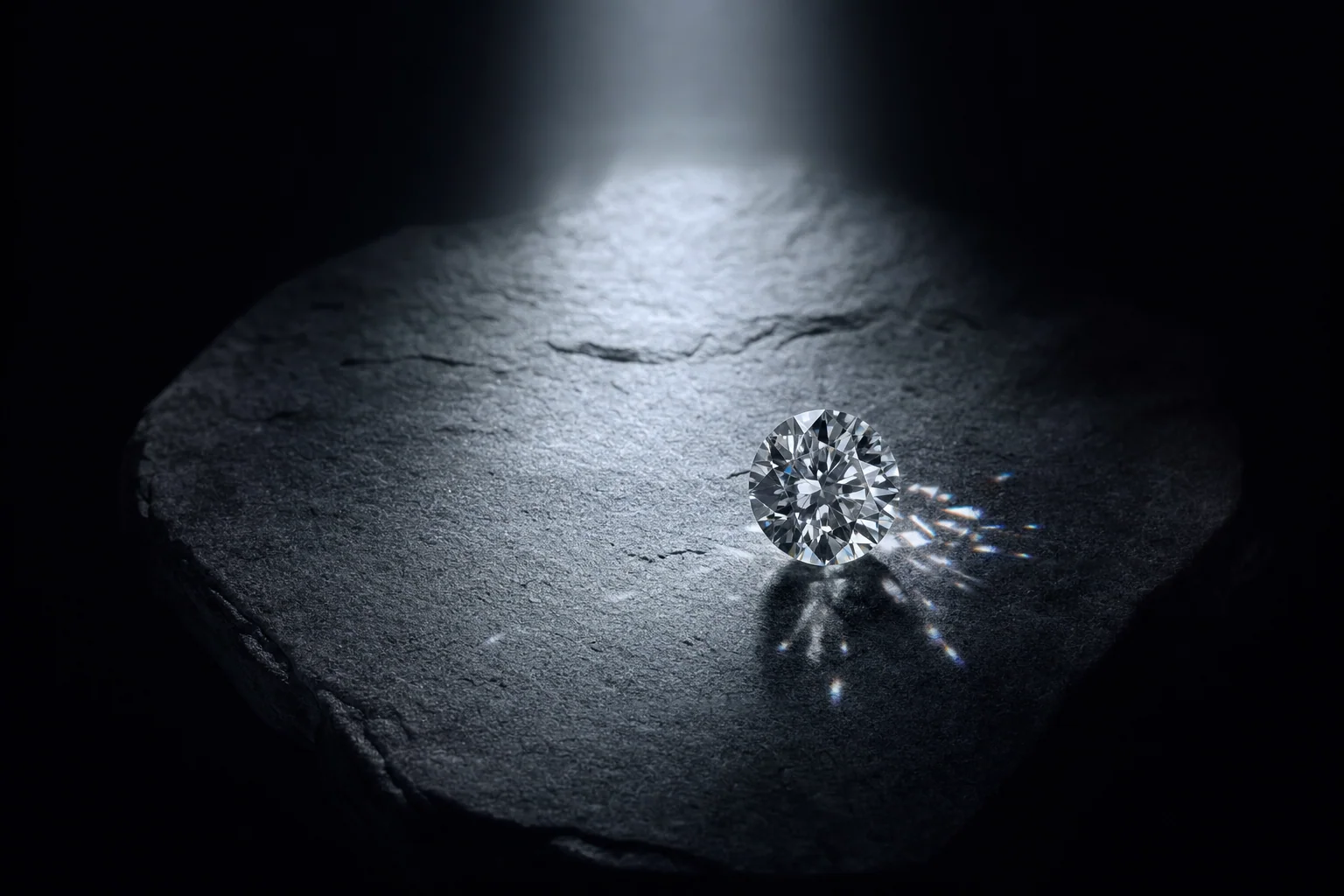
There is a category of writing about gemstones that lives between gemology and culture — the texts that treat the stone not as a mineral but as a symbol, and ask what wearing it does to the person who wears it. The best-known modern work in this category is The Book of Stones by Robert Simmons and Naisha Ahsian, a reference compendium that maps each gem to qualities of energy, intention, and inner state. The book sits next to the laboratory manual on many gemologists’ shelves: not because the two share a method, but because both are trying to describe what a stone is.
This article takes Simmons and Ahsian’s framework as a starting point and asks an honest question: why, across cultures separated by centuries and oceans, has the diamond been read in such consistent terms? The answer is partly chemistry, partly optics, and partly the human tendency to project — but the consistency is real, and worth understanding.
What gets projected onto diamond, and why
Across the literature, four qualities recur when diamond is described in symbolic terms.
Clarity. Diamond is the gem most often associated with mental and spiritual clarity — the cutting through of illusion, the seeing of what is actually there. The association is straightforward optically: transparent, colourless, refractive, and far more luminous than most other transparent gems. A diamond does not soften light; it amplifies and divides it.
Strength. Diamond is the hardest natural mineral. The Sanskrit vajra — thunderbolt, indestructible — is the same word that names the diamond. Across virtually every culture that knows the stone, it has been read as a metaphor for invulnerability, willpower, resilience.
Light. Diamond is unusually high in both refractive index (2.42) and dispersion (0.044). In a well-cut stone, white light enters, bounces, splits into spectral colours, and returns. The eye reads it as a small generator of light. The symbolism follows: enlightenment, illumination, divine radiance.
Amplification. This is a more specialised claim, found especially in modern metaphysical writing: that diamond strengthens whatever it is near. Other stones, other intentions, the wearer’s own energies. The basis for the claim in the literature is partly the dispersion-and-fire optical behaviour, partly the diamond’s role in healing-stone practice as a “carrier” gem, and partly the simple cultural inheritance that diamond is the apex stone and therefore behaves as such.
These four qualities — clarity, strength, light, amplification — show up in Hindu, Greek, Roman, medieval European, and modern New Age texts with such regularity that it is hard to dismiss the convergence as coincidence. The diamond’s physical properties suggest the symbolism, and the symbolism, once established, reinforces itself across generations.
Chakra and elemental associations
In the chakra system as it appears in modern metaphysical writing, diamond is most often associated with the crown chakra — the energy centre at the top of the head, governing connection to higher consciousness and the divine. The pairing is intuitive: a colourless, luminous, clear stone matched to the highest, most ethereal chakra.
A smaller tradition associates diamond with the third eye chakra, particularly when the diamond is used in meditation practices oriented toward insight and clear perception. Both placements share the same underlying logic — diamond as the stone of clear seeing, whether that seeing is directed inward or upward.
Elementally, the diamond is most often classified with fire — the element of transformation, passion, and refining heat. The pairing reflects both the optical fire of the stone and its origin: diamonds are forged at extreme temperature deep in the Earth, the geological equivalent of refining. The fire association also bridges the older mythology, in which diamonds were understood as solidified lightning.
Healing properties as the tradition describes them
It is worth being clear about register: when modern metaphysical literature describes a stone’s “healing properties,” it is using the word healing in a specific way — to describe the effects on emotional, energetic, and spiritual state rather than on physical illness. The tradition does not claim that wearing a diamond cures cancer. It claims that diamond, when worn or held with intention, supports certain states of mind.
For diamond, the recurring claims are:
- Detoxification of emotional and energetic accumulations. The diamond is said to “clear” — to lighten the wearer’s field, to make stuck patterns more visible and therefore more workable.
- Reinforcement of willpower and resolve. Diamond is the stone the literature recommends most often for someone who has committed to a difficult path and is trying to maintain the commitment.
- Support for honesty. Diamond’s clarity is said to inhibit self-deception — to make it harder, while wearing the stone, to lie to oneself.
- Protection against scattered or absorbed energies. Diamond is dense, focused, and (the tradition argues) energetically self-contained; it is said to shield the wearer from environments that would otherwise drain them.
Whether one takes these claims literally, metaphorically, or simply as a way of articulating one’s intention with the piece, the tradition is internally consistent and useful as a framework for thinking about why a wearer might choose a particular stone for a particular moment.
The diamond as a gift
The most consistent symbolic use of the diamond, across every culture that has encountered it, is as a gift between two people who intend to remain bound. The use is old — Mughal emperors gifted diamonds at moments of political alliance, medieval European royalty gifted them at moments of betrothal, modern partners gift them at moments of engagement — and the meaning has remained remarkably stable across the contexts.
What the gift is understood to convey is some combination of permanence (the stone is hard; the bond is hard), clarity (the stone is transparent; the intent is transparent), and amplification (the stone increases what passes through it; the gift increases what is between the two people). The wearing of the gift, in turn, is understood as a quiet daily act of remembrance — the same stone, on the same finger, year after year.
A diamond carried in this way is, in a real sense, not merely an ornament. It is a small physical commitment that travels with the person, and that is what makes the symbolism so durable across cultures. The mineral does not change. What it has been asked to mean does.
How to think about all this
A reader can hold the symbolic and the scientific accounts of a diamond at the same time without contradiction. The mineral is what it is — a piece of crystallised carbon with specific optical properties. The symbolic readings are what cultures have done with that mineral over thousands of years. Neither cancels the other.
A serious atelier respects both. The piece must be made well — proportions correct, setting durable, stone sound — and the piece must also be allowed to mean what the wearer needs it to mean. Documentation, provenance, care, and the long relationship that follows the piece across its life are the practical side. What the wearer reads into the stone is the personal side. The two together are what makes a piece worth inheriting.
A short reference
- Four recurring qualities: clarity, strength, light, amplification — present in nearly every culture that has known the diamond.
- Chakras: primarily the crown, sometimes the third eye.
- Element: fire — transformation, refining, illumination.
- Healing as the tradition uses the word: emotional and energetic, not physical-medical.
- As a gift: the most stable cross-cultural use, and the reason the engagement-ring tradition is so durable.
A diamond carries what the wearer is willing to put into it. The mineral does the rest.