
gemstones
The Marvels of Gemstones
A short course in the physics of fine gems — crystal systems, hardness, cleavage, optical properties, and the slow geology that produces every stone worth setting.
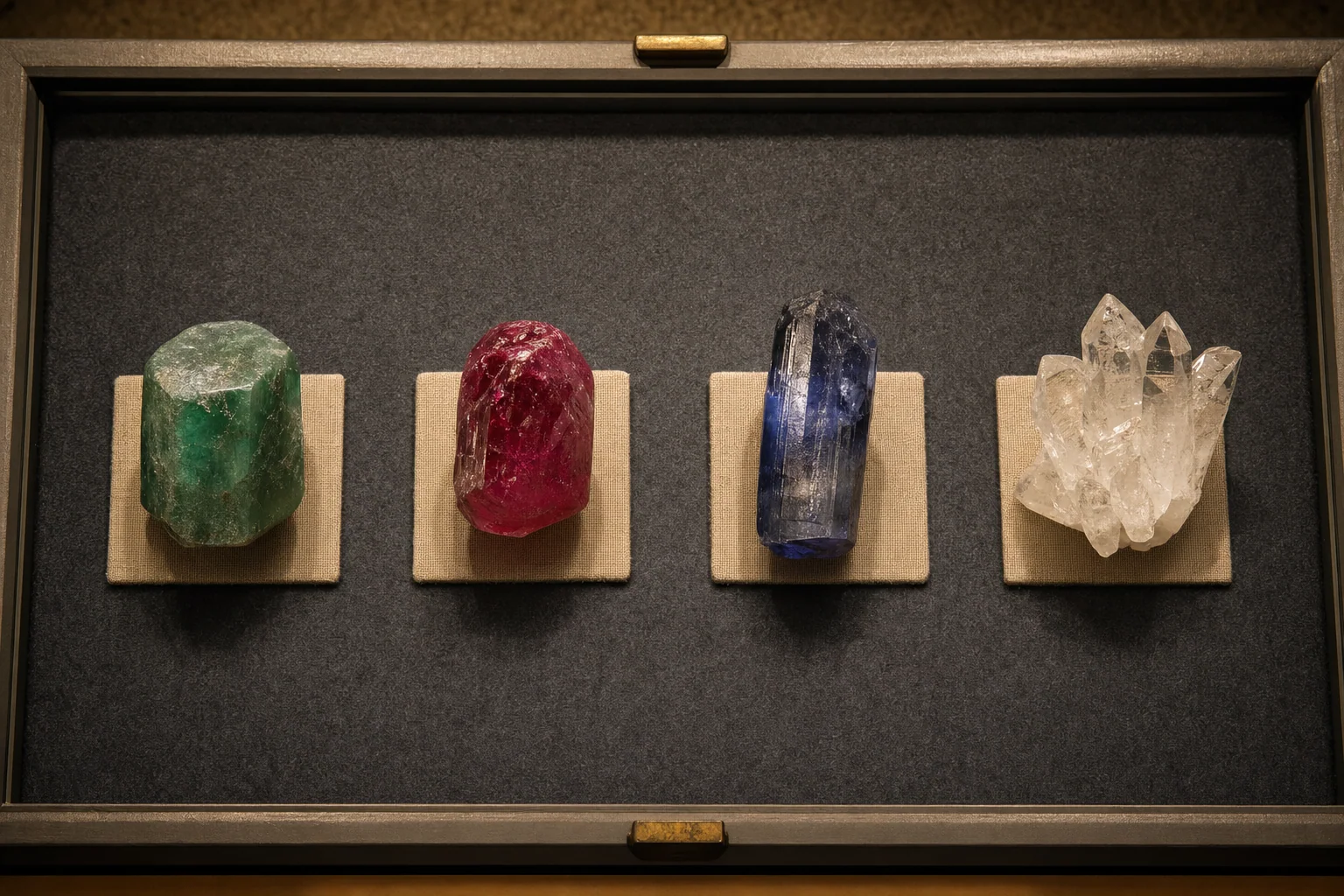
A gemstone is one of the slowest objects a human will ever hold. Most of the stones that pass across a jeweller’s bench began forming hundreds of millions of years ago, in conditions of temperature and pressure that no atelier can reproduce, and were carried to within reach of human hands by tectonic accidents that the trade still struggles to forecast. Understanding a gem — really understanding it — means understanding what it is, how it formed, and why it behaves the way it does in light.
This is the territory of gemology, and the texts that the field returns to most often are the patient, methodical reference works: laboratory manuals, mineralogical handbooks, the kind of book that explains crystal systems before it explains carat weight. What follows is a brief tour of the foundations — the marvels behind the marketing.
The geometry of a crystal
A gem is, almost without exception, a crystal — a solid in which the atoms occupy a repeating, ordered three-dimensional pattern. The pattern can take seven basic shapes, called crystal systems: cubic, tetragonal, hexagonal, trigonal, orthorhombic, monoclinic, and triclinic. Each gem species belongs to one of these systems, and the system controls almost everything else about the stone — its outward form, how it breaks, how it bends light.
Diamonds are cubic — their carbon atoms arranged on the corners and faces of a cube. This is why a rough diamond, when freshly mined, often appears as a small octahedron, two pyramids fused base to base. Emeralds are hexagonal — six-sided prisms that grow upward like miniature columns. Corundum (the species that contains both rubies and sapphires) is trigonal — three-fold symmetry, expressed in barrel-shaped or tabular crystals. Quartz is also trigonal, which is why its rough crystals look so similar to corundum’s despite being chemically unrelated.
A trained gemologist can identify the species of an unknown rough stone partly by the symmetry of its form alone. The crystal system is the gem’s first signature.
Hardness, cleavage, density — the three physical numbers
After the crystal system, three physical properties define how the stone behaves in the world.
Hardness is measured on the Mohs scale, from 1 (talc) to 10 (diamond). It is a relative scale — a stone of higher number scratches every stone below it. Diamond at 10 is the only material that scratches another diamond; corundum at 9 is the next hardest, which is why rubies and sapphires are well-suited to daily wear; emerald sits around 7.5 to 8 but is brittle, which is a separate problem. The trade speaks of hardness because it determines what a stone can survive in a setting worn every day on the most-used hand of the body.
Cleavage is the tendency to split along specific atomic planes. Diamonds have perfect octahedral cleavage in four directions, which is why a cutter can split a rough diamond along a precise plane — and also why a sharp blow to a corner of a finished stone can fracture it. Emeralds have indistinct cleavage but are full of internal stresses that make them prone to fracturing. Corundum has no true cleavage, which contributes to its toughness even at high hardness.
Density — also called specific gravity — is the ratio of the stone’s mass to the mass of an equal volume of water. Diamonds run around 3.52, emeralds around 2.72, rubies and sapphires around 4.00, quartz around 2.65. A trained gemologist can sometimes identify a stone by weighing it in air and then in water and computing the ratio. Density is also why a one-carat ruby looks smaller than a one-carat emerald: same weight, smaller volume because the ruby is denser.
What colour really is
The most familiar thing about a gem is its colour, and the colour is almost always a trace-element story. The base mineral of an emerald is colourless beryl. Add a small percentage of chromium (and sometimes vanadium) and the same beryl becomes emerald — the chromium absorbs red and violet wavelengths and lets green through. The base mineral of corundum is colourless aluminum oxide. Add chromium and you get ruby. Add iron and titanium together and you get blue sapphire. The chromistry is delicate: a few hundred parts per million of one element shifts the stone from one identity to another.
Beyond hue, gems exhibit dispersion — the splitting of white light into spectral colours as it passes through the stone. Diamonds have unusually high dispersion (0.044), which is why a well-cut diamond throws coloured flashes of “fire” as it moves in the light. Most coloured stones disperse less than diamond and so do not flash the same way; their visual life comes from the body colour and from internal reflections off the pavilion facets.
Some gems also exhibit pleochroism — different colours when viewed from different angles. Tanzanite, in its natural state, can appear blue from one direction, violet from another, and brown from a third; the cutter chooses the orientation that gives the best face-up colour.
How gems form
Every gem species is born under specific geological conditions, and the conditions are rarely common. Diamonds form at depths of 150 to 200 kilometres in the Earth’s mantle, under pressures so extreme that pure carbon assembles itself into a tetrahedral lattice. They reach the surface only when explosive volcanic eruptions, called kimberlite pipes, tear vertically through the crust and carry the diamonds with them. The eruptions themselves are ancient — most occurred between 50 million and 2 billion years ago — so the kimberlite pipes are the entry points to a geological elsewhere.
Emeralds form much closer to the surface, in hydrothermal veins where mineral-rich fluids meet host rocks containing chromium or vanadium. The Colombian emerald belt of Muzo, Coscuez, and Chivor is a particularly rare geological accident: the right host rocks meeting the right fluids at the right pressure. Most of the world’s finest emeralds, even today, come from this specific stretch of Andean foothills.
Rubies and sapphires form in metamorphic environments — recrystallised marbles, weathered basalts, alluvial deposits where the gems have been freed from their host rock by erosion and concentrated in riverbeds. Each major source produces stones with subtle but real signatures: Kashmir sapphires have a velvety silk that catches light differently than Burmese stones, which differ again from Ceylon stones, which differ again from Madagascan ones. A gemological laboratory can often identify origin from inclusions and trace-element profiles alone.
What gets measured, gets remembered
The reason any of this matters is practical. A gemstone is a small, valuable, and surprisingly fragile object, and a great deal of what the trade calls “trust” comes from being able to describe a stone in terms that survive transportation across borders and generations.
The disciplines built around this — laboratory grading, origin determination, treatment disclosure, ÊTRUNE-style digital records — exist because the alternative is a market run on assertion. A stone whose physics are recorded is a stone that can be inherited with confidence. A stone whose only documentation is a story is a stone whose value collapses the moment the story is questioned. See ÊTRUNE ID for how we document this for each piece.
A short reference
- Crystal system controls form, cleavage, and optical behaviour. Seven systems; every gem belongs to one.
- Hardness, cleavage, density are the three physical numbers that determine how a stone behaves in the world.
- Colour is almost always a trace-element story — a few hundred parts per million can change the species.
- Dispersion and pleochroism are why a well-cut diamond flashes fire and why some stones look different from different angles.
- Formation matters because origin is value: the same species from different sources commands different prices and tells different stories.
A gem, properly understood, is geology made small and portable. The marvel is not that it is beautiful. The marvel is what it took to get here.