
gemstones
The Art and Science of Describing Precious Stones
How the language of the Four Cs — colour, clarity, cut and carat — gives a gemstone a vocabulary that survives the room it is described in, the buyer it is sold to, and the decades it will be worn.
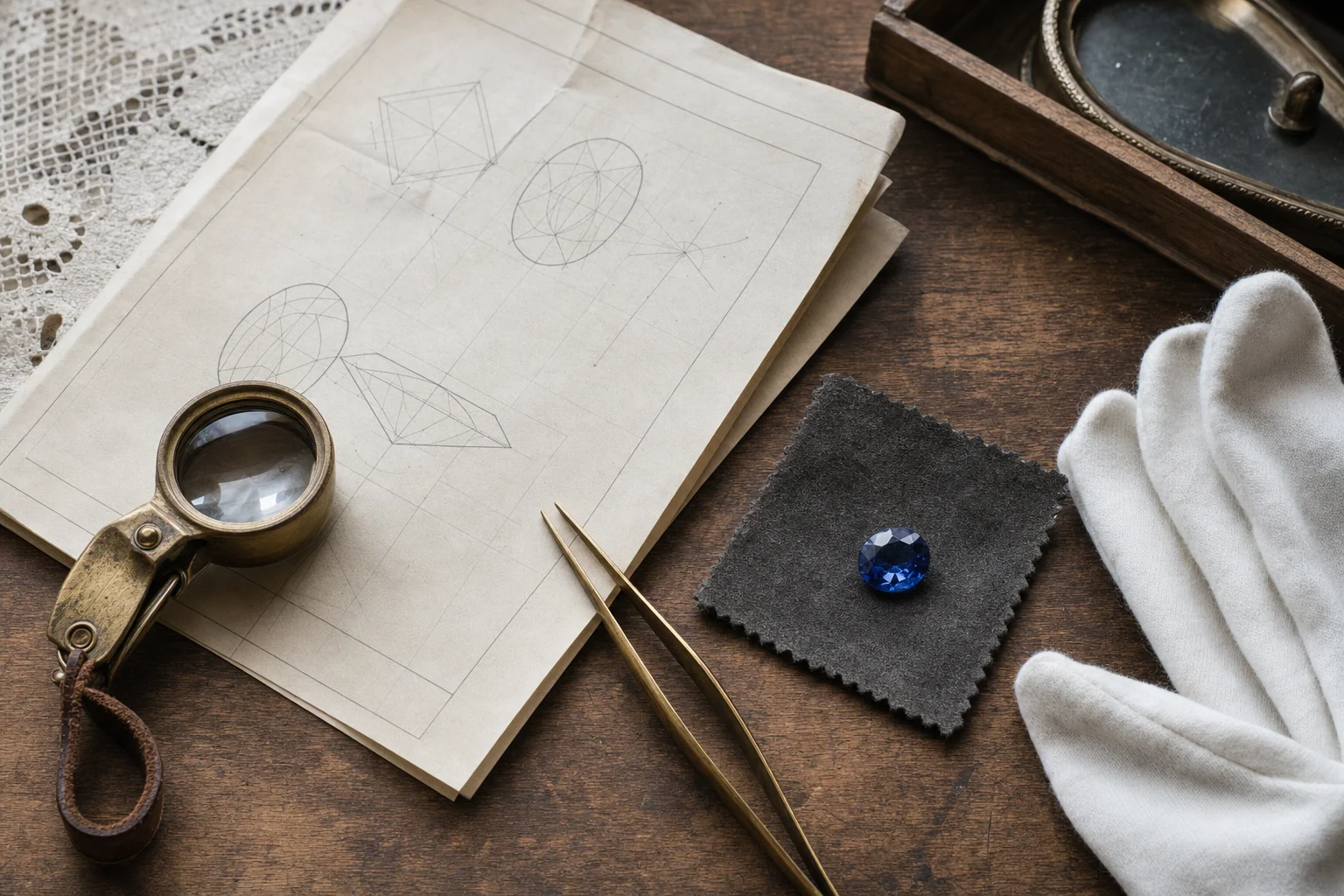
A gemstone, before it is bought or worn, is described. The description is what travels: across continents, across decades, across the conversation between an atelier and the person who will eventually wear the piece. A well-described stone is a stone whose qualities can be verified by a third party who never held it. A poorly described one is a story, and stories tend to drift.
The discipline that turns a piece of crystallised mineral into a record is called gemology, and its central method — what every laboratory, every auction house, every serious atelier uses — is built on four anchors: colour, clarity, cut, and carat weight. The Four Cs, originally formalised for diamonds by the Gemological Institute of America in the mid-twentieth century, have been adapted, with care, to coloured stones as well. They are not the whole picture of a gem, but they are the frame inside which the picture has to fit.
Colour — not just a word
The temptation, when describing a stone, is to reach for the colour name and stop. The stone is blue. The stone is green. The stone is red. But gemological colour has three components, all of which a careful description records.
Hue is the basic position on the colour wheel — blue, green, red, violet, and the modifiers in between (slightly violetish blue, strongly orangish red). Hue alone is rarely the whole story.
Tone is the lightness or darkness of the colour. A pale sky-blue sapphire and a deep midnight-blue sapphire share a hue but live at opposite ends of the tone scale. Tone affects value disproportionately: extremely light or extremely dark stones almost always trade below the mid-tone equivalents.
Saturation is the intensity of the colour — how vivid it is, how far from grey or brown. A richly saturated emerald reads as vibrant green; a desaturated emerald reads as greyish-green. Saturation, more than any other single variable, is what separates a great stone from a good one.
Describing colour properly means stating all three. “A vivid medium-tone slightly bluish green” is a gemological sentence. “A pretty green” is a marketing sentence. The first survives translation across languages, certificates, and decades. The second does not.
Clarity — the inside of the stone
Every natural gemstone has internal features. Some are absences — voids, fractures, cleavages. Some are presences — included crystals of other minerals, the gem’s “fingerprint.” In diamonds, the trade prefers stones that are as free of inclusions as possible, and the modern grading scale (FL, IF, VVS1, VVS2, VS1, VS2, SI1, SI2, I1, I2, I3) reflects that preference with great precision.
Coloured stones are different. Emeralds are expected to have a jardín — a garden of inclusions — and a flawless emerald is rare to the point of suspicion. Rubies and sapphires often carry “silk,” tiny needle inclusions of rutile that, when fine enough, soften the way light moves through the stone. Some inclusions are evidence of origin: certain silk patterns belong specifically to Burmese rubies, certain growth zones to Kashmir sapphires.
A clarity description, then, is not a verdict on whether a stone is “clean” or “flawed.” It is a record of what is inside the stone, at what magnification it is visible, and what it means about the stone’s identity and history. A coloured-stone lab report will sometimes diagram the inclusions, as carefully as a botanist diagrams a leaf.
Cut — what the human does to the stone
Of the Four Cs, cut is the one that is not given by nature. Colour, clarity, and carat weight are determined by what happened underground, over millions of years. Cut is the decision of the cutter, made once, irrevocably, when the rough stone meets the wheel.
A good cut does three things. It places the stone’s table — the broad top facet — so that light enters cleanly and exits through the crown. It balances the proportions of the crown above the girdle with the pavilion below, so that the light bouncing through the pavilion returns to the eye rather than leaking out the bottom. And it polishes the facet junctions sharply enough that each facet behaves as its own little mirror.
A poor cut squanders. A diamond with perfect colour and clarity, cut shallow, will look glassy and lifeless. A sapphire cut too deep will read as too dark, however vivid its colour at the rough stage. The cutter’s job, then, is not merely to shape the stone — it is to release what the stone already contained. This is why fine cutting is one of the slowest, most expensive operations in the gem trade: a single rough may sit on a cutter’s bench for weeks while they study the orientation of the colour and the inclusions.
Carat weight — size, calibrated
A carat is two hundred milligrams. It is divided into one hundred points, so that a stone is sometimes described as “75 points” rather than “0.75 carats.” The unit is venerable — it derives from the seed of the carob tree, which medieval traders used as a counterweight because of its remarkably consistent mass — and it is, today, the only one of the Four Cs measured with absolute precision. A scale calibrated to two decimal places can settle the question.
What carat weight is not, however, is a measure of size. Two diamonds of identical weight can look quite different on the hand: a shallow cut spreads the stone wider across the finger, while a deep cut concentrates the mass below the surface. For coloured stones the variance is even greater, because the densities differ from species to species. A one-carat ruby is physically smaller than a one-carat emerald, because corundum is denser than beryl.
A description that records only the weight, then, is incomplete. A proper measurement records weight in carats, the longest and shortest face-up dimensions in millimetres, and the total depth. These four numbers together describe the actual object in space, not just its mass.
Why standardisation matters
The reason for all this — the reason the trade has built such a precise vocabulary — is that a gemstone is, in a deep sense, a small object asked to do a large job. It travels through borders, through years, through generations of owners. The market for fine stones works only because a gem described in Bangkok can be evaluated in Geneva using the same words.
Standardisation is the boring foundation that makes every interesting thing — auctions, certificates, inheritance, ÊTRUNE ID, the secondary market — possible. Without it, a gem is reduced to whatever its current holder claims it to be, and trust is rebuilt from scratch with every transaction.
A short reference
- The Four Cs: colour, clarity, cut, carat weight.
- Colour is hue + tone + saturation, not just a name.
- Clarity records what is inside the stone, not just whether it is “clean.”
- Cut is the only one of the four that depends on a human decision.
- Carat weight is precise but not the same as size; record dimensions too.
- Why it all matters: the description is what makes a stone tradeable, certifiable, and inheritable.
A gemstone described well is a gemstone that can outlast its first owner. That is the quiet ambition behind the vocabulary.