
gemstones
Understanding Sapphire Origins
Madagascar, Sri Lanka, Montana — what changes when the origin changes, how to read a provenance certificate, and why the same colour can mean very different things.
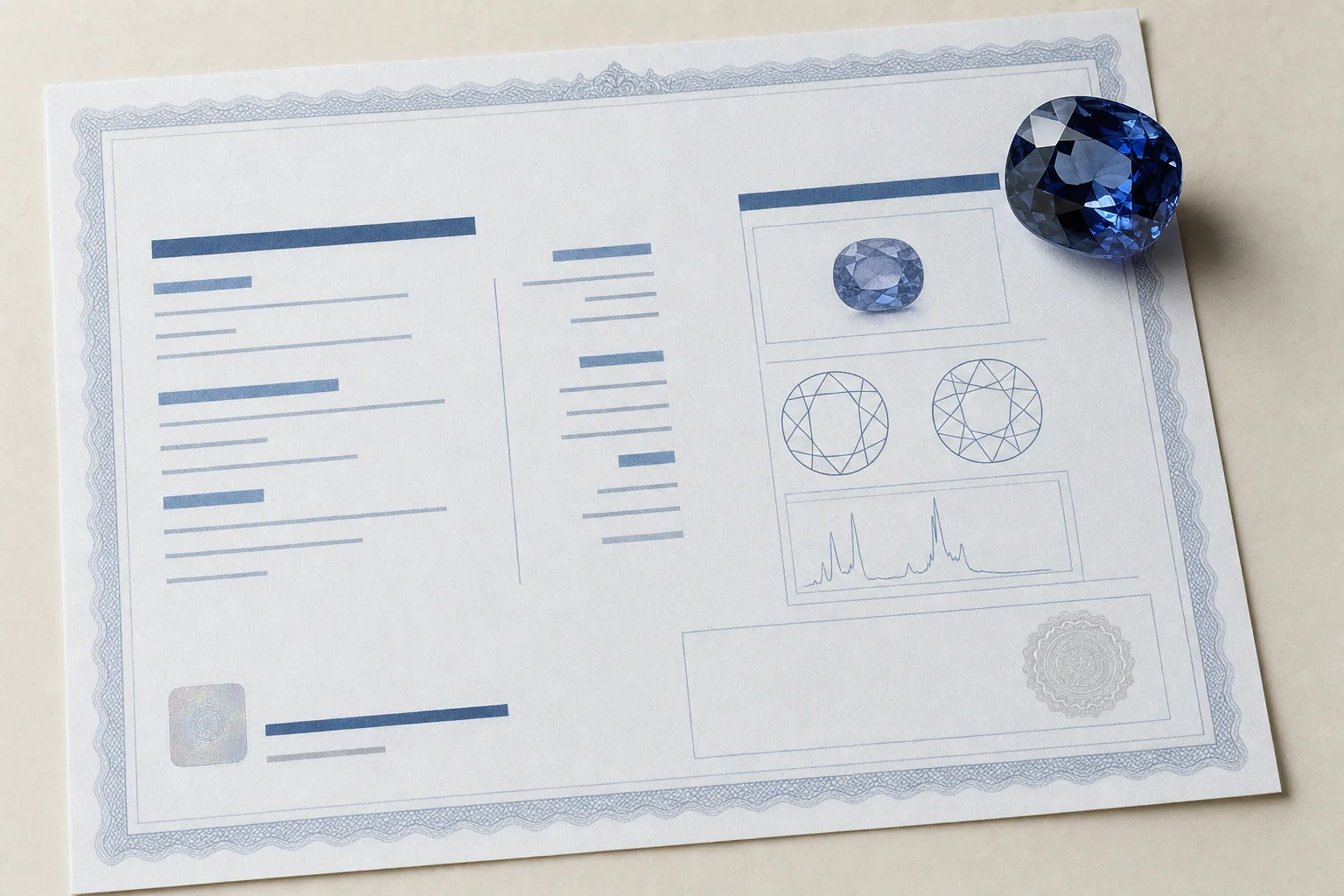
A sapphire is corundum — aluminium oxide with trace elements that decide the colour. Two stones can share the exact same hue under daylight and still be quietly different objects: same chemistry, same hardness, same finished beauty, but separate biographies underneath. The difference is the ground they came from. This guide walks through what changes when a sapphire’s origin changes, how a certificate communicates that, and why the same colour can mean very different things to a gemologist and to a market.
Why origin matters at all
Sapphires are not faceless. The deposit a stone was extracted from tells you about the geological conditions it grew under — and those conditions leave traces inside the crystal that a trained eye can read.
A Madagascar sapphire was likely born in a metamorphic environment, surrounded by particular silk-like rutile inclusions. A Kashmir sapphire — the historical reference for blue — emerged from a remote Himalayan deposit whose specific velvety appearance has never been matched anywhere else. A Montana sapphire came up from alluvial gravels in the American West, with a slightly different growth signature.
None of these are better or worse in absolute terms. They are different. The market, the collector, and the wearer all care about that difference for their own reasons.
What a sapphire certificate actually tells you
A certificate from a reputable gemological laboratory — GIA, SSEF, Gübelin, AGL — is not just a stamp of authenticity. It is a structured description of a single stone, written so any other lab could read it and arrive at the same identification. The fields that matter most:
Species and variety. “Corundum” is the species; “sapphire” is the variety. A pink sapphire and a ruby are both corundum, separated only by colour intensity.
Weight, dimensions, shape. The carat weight in three decimals; length, width, depth in millimetres; the cut shape (cushion, oval, round brilliant). These define the physical object precisely.
Colour. Described in standardised terms — the GIA uses combinations of hue (the basic colour), tone (lightness/darkness) and saturation (purity). “Vivid blue”, “medium royal blue”, “greyish-blue” are technical descriptors, not marketing.
Clarity. Sapphires are Type II by default — they typically contain visible inclusions. The certificate notes whether the stone is eye-clean and describes any silk, fingerprints or feathers worth recording.
Treatment. Did the stone undergo heat treatment to improve colour? Diffusion? Glass-filling? These are common practices; what matters is full disclosure. A “no heat” or “no thermal enhancement” notation is significant — it raises the value substantially, especially for fine blue sapphires.
Origin. When a lab can identify the origin with confidence, the certificate names it: Kashmir, Burma (Myanmar), Sri Lanka (Ceylon), Madagascar, Mozambique, Australia, Montana, and so on. If origin cannot be determined with confidence, the lab leaves it open rather than guess.
Reading colour across origins
The same descriptor — “blue sapphire” — covers a wide spectrum.
Kashmir sapphires are described, when they appear, as having a velvety appearance: a soft, slightly milky scatter caused by extremely fine silk inclusions. The colour is a slightly violetish blue of medium saturation. Few new stones come out of that ground; what circulates today is mostly historical material.
Burmese (Myanmar) sapphires often display a richer, slightly purplish royal blue. The deposits at Mogok are famous, but the political situation means contemporary supply is complicated.
Sri Lankan (Ceylon) sapphires tend toward a lighter, more luminous blue, often with a pleasing transparency. The market historically prices Ceylon material a tier below Kashmir/Burma for the same colour, though exceptional Ceylon stones command exceptional prices.
Madagascar sapphires emerged commercially in the 1990s and now represent a significant share of fine blue sapphires on the market. The colour can range from pale to deeply saturated; some Madagascar material rivals Sri Lankan in appearance and is priced accordingly.
Montana sapphires — particularly from Yogo Gulch — have a distinctive cornflower blue and rarely require heat treatment. They are smaller on average but increasingly sought after by collectors who value the American provenance and the no-heat distinction.
Same colour, different stones
Two cushion sapphires of the same size, same colour, same cut, sitting next to each other under a lamp, can have wildly different stories — and prices.
If one is a Kashmir, no-heat, well-cut, eye-clean stone, the certificate alone moves the conversation into a different category. If the other is a fine Madagascar, no-heat, beautifully cut — also exceptional, but in a different market segment.
The wearer often cannot see the difference at all. A trained gemologist can, sometimes, but even labs work hard to distinguish certain origins. This is why a certificate from a top-tier lab matters: when a stone is sold as Kashmir-origin, the buyer is paying for the certainty written on that piece of paper.
What we do at ÊTRUNE
Every sapphire that enters an ÊTRUNE piece arrives with its certificate. We work with stones whose provenance we can document, whose treatments are disclosed, and whose journey from mine to atelier we can describe to the person who will eventually wear them. The information lives in the ÊTRUNE ID record of the finished piece, available across generations.
When you choose a sapphire for your ring, knowing the origin is not a luxury — it is part of what you are choosing. A Madagascar teal sapphire and a Sri Lankan cornflower will both be beautiful. They will be different beautiful, and the difference is worth understanding before the ring is built.
A short reference
- Hardness: 9 on Mohs scale. Excellent for daily wear, second only to diamond.
- Common treatments: Heat (very common, generally accepted); diffusion (significant; less valued); glass-filling (disclosed but generally avoided in fine jewellery).
- Key labs: GIA, SSEF, Gübelin, AGL.
- Key fields on a certificate: weight, dimensions, colour (hue/tone/saturation), clarity, treatment, origin.
- Most asked origins for fine blue sapphires: Kashmir (historical), Burma, Sri Lanka (Ceylon), Madagascar, Montana.
Understanding the origin is the first step in choosing a sapphire with intention. The next step — choosing how the stone is set, how the piece will be worn, how it will travel through your life — is what the atelier is for.